
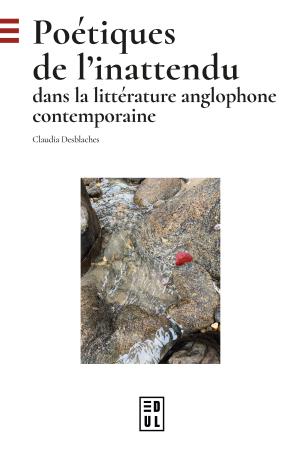

Poétiques de l’inattendu dans la littérature anglophone contemporaine is a rare and rewarding work that dares to think across forms, disciplines, and world views. While its title points to short fiction as its central focus, the book unfolds as a wider meditation on contemporary poetics – embracing both narrative and poetry. In doing so, it draws a vital thread between literary creation and epistemological transformation, guided by the motif of the unexpected as a defining feature of the contemporary literary imagination.
This insightful and original book investigates how literature makes space for uncertainty – not simply as a theme, but as a mode of composition and a philosophical stance. In exploring the dynamics of unpredictability in short stories and poems alike, the author invites us to see the unexpected not as rupture or deviation, but as a structuring principle of artistic thought. Whether in a narrative that engages with genetics or in a poem that takes quantum theory into account, the unexpected here functions as an opening: a break in familiar perception that allows for new forms of relation, meaning, and being.
With elegant and rigorous analogies, the book shows how literature and science – especially physics – share a common interest in indeterminacy, multiplicity, and entanglement. Since literature does not need external validation, this is not an effort to flatten narrative into scientific metaphor, nor to claim scientific authority for poetic composition. Rather, the work traces a network of resonances: how poems and stories today actively shape a world increasingly understood not through linear causality or stable identity, but through probabilities, potentialities, and entangled perspectives. Literature here functions as a dynamic force – reconfiguring relationality, opening itself towards expanded modes of experience, and amplifying the ways through which we conceptualize existence.
The author’s impressive critical readings are attentive to the specificities of both genres. In fiction, she identifies how certain short stories suspend narrative resolution or bend chronology to open unexpected paths. In poetry, she traces how syntax, rhythm, and semantic depth cultivate a space of cognitive and emotional openness. Across genres, the analysis remains sensitive to language’s capacity to destabilize as much as to stimulate, to gesture rather than to define. Claudia Desblaches demonstrates a rare ability to synthesize literary analysis with readerly agency, allowing the unexpected to emerge not only in the works studied but in the interpretative gestures themselves.
Ultimately, what makes C. Desblaches’ scholarship outstanding is her fearless curiosity and engagement with the most challenging and demanding works. What’s more, in this book, she reveals a unique brand of criticism predicated on her ability to carry out close readings of fiction and poetry that are either produced with unusual (read: unexpected) media and materials or written in dialogue with other disciplines. This is a book for readers and scholars who believe that literature has the power to not just reflect the world, but reconfigure it.