

Introduction
A Contextualised and Essentially Contested Relationship
This book is the result of an international conference held at the University of Lorraine in 2022. The event was organised by Interdisciplinarité dans les études anglophones (IDEA, UR 2338) at the University, with partners from the University of Strasbourg (SEARCH, UR 2325), the University of Hull, TRIANGLE (UMR 5206), and the Centre de recherches en civilisation britannique (CRECIB). This two-day event featured contributors from various disciplines dealing with the concepts of power and knowledge. Our ultimate aim was and is to provide a space for different studies which, when brought together, draw out the ambiguous character of these two concepts. At the same time, the diversity of approaches and areas brings out both the richness of these ideas and the complex and dynamic relationships in which they stand to each other.
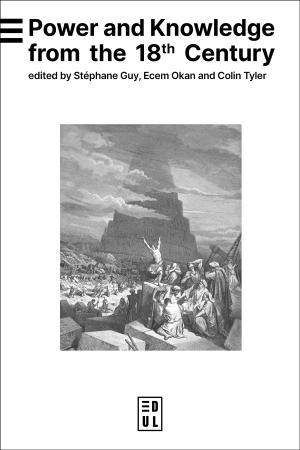
What better illustration of the diversity that results from unity is there than Gustave Doré’s (1832–83) The Confusion of Tongues, an etching that we chose as the basis for both the conference poster and the book cover? This magnificent work of art is an interpretation of the biblical story of the Tower of Babel in Genesis (11:1–9), where a united humanity speaking a single language decides to build a city in which all peoples can live. At its heart, they erect a tower tall enough to reach the heavens. God punishes humanity for this act of hubris, creating arbitrary divisions among them, confusing their speech and scattering them throughout the world. In this way, they become strangers to one another.
This deus ex machina event of diversification and division has inspired tree thinking in linguistics and branching processes of complexity in biology. It has even more direct implications for our two main concepts. A core lesson of the original story is that knowledge and power go hand in hand. The power of being united in language fuelled humanity’s ambition not merely to reach God, but rather to become God. Threatened in His attributes of omnipotence and omniscience, God took knowledge away from humanity, thereby rendering it powerless against Him. Without a unity of language and ambition, humanity was condemned to confusion and conflict. Not knowing each other created fear and the desire to dominate. One might wonder whether it is a coincidence that the building of towers in cities has often been a demonstration of power in different times and places.
The notion that ‘knowledge itself is power’ was first formulated by Francis Bacon in 1597 in his Meditationes Sacrae (Bacon, 1857–74, vol. 14, p. 95). By bringing together those concepts, Bacon raised issues that societies have been confronted with ever since. The implications of such a connection are several. First, knowledge serves to emancipate humanity from the tyranny of natural conditions. Second, from a programmatic perspective, power should be entrusted to a knowledgeable class. Third, the scientist, the expert, the intellectual needs to abide by certain disciplinary rules, be they ethical, civil, or methodological.
These issues are complicated immensely by the fact the term ‘power’ has been used in radically different ways by individuals and groups, in a multitude of historical, intellectual and practical contexts. Steven Lukes has famously distinguished three broad meanings or ‘dimensions’ of ‘power’. Roughly, these equate to: power as direct, overt control of one identifiable agent by another (physical coercion being the clearest instance); power as the more or less covert manipulation of one identifiable agent by another; and power as the control of multiple agents by an impersonal system (as exemplified in Marxist theories of control of all classes by the logic of capitalism) (Lukes, 2005, pp. 25–29). There is no neutral position from which to determine the ‘most appropriate’ meaning of the term ‘power’. As Lukes observes, ‘[o]ne feature which these three views of power share is their evaluative character: each arises out of and operates within a particular moral and political perspective… [In this sense, “power” is] an “essentially contested concept”… Indeed, to engage in such disputes [about the meaning of the term] is itself to engage on politics’ (Lukes, 2005, pp. 29–30). This essential contestability of the concept of ‘power’ ensures the essentially contested character of any intellectual or practical relationship in which power plays a part.
Debates regarding the most appropriate meaning of the term ‘knowledge’ have also flourished, each with their own presuppositions and wider ‘worlds of ideas’ (Tyler, 2009; Boucher, 2016). Where Plato saw understanding the forms as being the pinnacle of knowledge, others have conceived this pinnacle in religious terms as insight resulting from divine inspiration, or in Romantic terms as an intuitive awareness of the individual’s true nature. Others have eschewed philosophical and theological conceptions in favour of tradition and practice-based knowledge, whereas yet others have looked to technocratic forms of knowledge. The ways in which these perspectives shift over time frequently have epochal significance. Hence, the downfall of the Ancien Régime prompted by the Romantic ideas of the French Revolution caused European societies to adopt a new conception of time. Stemming from a revival of Enlightenment ideals, time came to be seen as the unravelling of a rational process. This process was structured as what came to be called a ‘stages view of history’, whereby societies move from savagery to barbarism to civilisation. In the nineteenth century, with figures such as Georg Wilhelm Friedrich Hegel and Auguste Comte, the philosophic historian emerged as not merely an observer but as an interpreter and a prophet, who came to fill – and, indeed, fulfil – the void left by the collapse of certainties (Hegel, 1956, pp. 18–19; Comte, 1865, pp. 33–40). Such teleological approaches to history had already been questioned by Romantics including Johann Gottfried von Herder for whom, in his early writings such as ‘Older Critical Forestlet’, the past should be judged purely in its own terms (Herder, 2002, pp. 257–67). This non-teleological position was developed more consistently by later academics such as Leopold von Ranke, who used the systematic study of primary sources as a bulwark to resist the preconceptions of teleological historicism (Ranke, 2010).
The link between these positions and those relating to the nature and mechanisms of power are the focus of much work in social and political theory, sociology and political science. A key issue here is control of access to the means of acquiring existing knowledge and generating new knowledge. Hence, for Plato, knowledge of the forms was available only to philosopher-rulers whose innate exceptional potentials were drawn out through an extended educational programme. Access to the reins of power was thereby validated by an individual’s innate potentials and, just as crucially, access to a certain set of social institutions. In many religions, divine inspiration was available only to members of the preordained group of the Elect. Other believers and Romantics held that in principle, say, the laws of nature were understandable by all individuals once they escaped the prejudices imposed upon them by their lives among imperfect institutions (Calvin, 1960, Book 3, Chapter 24; Locke, 1967, Section 6; Rousseau, 1991, pp. 37–43). Conservatives and classical liberals, such as Edmund Burke, Friedrich Hayek and Michael Oakeshott, saw ‘true’ knowledge as the preserve of people and institutions that have grown in unplanned and piecemeal ways, in certain institutional environments over extended historical periods (Burke, 1968; Hayek, 1944; Oakeshott, 1991, pp. 5–39). By contrast, access to and control of appropriate technology lies at the heart of many neoliberal forms of power based on computer and artificial intelligence, in ways that emerged from what John Kenneth Galbraith called the ‘planning system’ of corporate capitalism (Galbraith, 1973, Part 3).
In each of these cases, the possession of knowledge that is significant (conceived in different ways) depends upon one’s ability to access the means of gaining it. Individuals and organisations can have power to the extent that they possess that ability to enter that complex and regulated world. Even where there has been an agreement regarding the meaning of the term ‘knowledge’ and how to gain it, almost all knowledge-power dynamics remain inherently conflictual. In this way, whichever conception is endorsed, ‘power’ is an inherently relative concept. For example, an individual or organisation has power to the extent that its ability to access knowledge is greater than that of competitor individuals and organisations.
The twentieth century provided a particularly stark backdrop for the debate over the correlation of forms of power and knowledge. As Marxist predictions of capitalism’s inevitable collapse failed to come true, as so-called ‘scientific socialism’ proved unable to propel the proletariat into economic and political power, ideology became the new battlefield for the Left (Engels, 1958). For many disputants, a crucial step towards emancipation was to question the cultural domination of the bourgeoisie and to reappropriate the sphere of learning. Aiming to expose the ways in which ‘consent’ under capitalism is the product of a mechanical system, Antonio Gramsci targeted the producers of knowledge in bourgeois institutions but also implied that the social production of knowledge itself had to be mastered by the proletariat to end the distortion of truth (Gramsci, 1971, pp. 3–14, 332–43, 351–54). This position was developed influentially by anarchists such as Edward Samuel Herman, Noam Chomsky and others (Herman & Chomsky, 1995). Critical theorists such as Theodor Wiesengrund Adorno and Max Horkheimer launched a radical critique of technocratic consciousness, which they saw as entailing an oppressive blindness to humanistic dimensions that were essential components of true knowledge (Adorno & Horkheimer, 1997).
Just as influentially, both Michel Foucault and Pierre Bourdieu sought to challenge the objectivity of knowledge by analysing the context in which it emerges, the former arguing famously that knowledge not only gives power, but is the product of power (Foucault, 2001, pp. 11–15, 49–52, 83–87, 283–86; Bourdieu, 1992, pp. 52–79). Underlying both of their approaches was the drive to dismantle predetermined categories of thought and to break down the illusion of a value-free understanding of the world. In the course of time, Foucault came to believe that emancipation would emerge with knowledge not of the outside world, but of the self (Foucault, 1988). Beyond its ideological location, the postmodern questioning of epistemology has highlighted profound connections between intellectual disciplines and politics: the organisation of information flows as much from abstract methodologies as it does from self-interested strategies.
Focusing on often markedly different conceptions of ‘knowledge’ and ‘power’, each of the contributions to the present volume draws out their interrelationships at every turn, with each chapter examining a different broadly ‘political’ engagement, even when they do not focus on the operations of the formal organs of the state. This reflects the fact that, with arguments drawing on social, political and economic theory, the history of economic and political ideas and, more broadly, on intellectual history, this volume aims to reassess the power-knowledge paradigm through a series of transgressions of the boundaries of specialisms and fields of research. These interdisciplinary perspectives come at a time when the very essence of cognition and learning is being problematised by the environmental crisis, the instability of democratic cultures and institutions, tensions between ethics and individual emancipation, and the widening use of artificial intelligence. As this introduction has indicated already, these tensions can only be adequately grasped through historically diverse and interdisciplinary lens. The authors in this volume provide the reader with a rich set of resources that, taken together, constitute such a lens. They begin by showing that, at the dawn of modernity, knowledge was meant to form a whole that would free humanity from the constraints of nature. This vision became increasingly unstable until the processes of specialisation and professionalisation that began in the nineteenth century tended to separate politics, the natural sciences, economics, history and philosophy. Up until the late twentieth century, crossing disciplines was viewed suspiciously, as being tantamount to intellectual poaching. It appeared at best as a dubious undertaking and at worst as a disingenuous reappropriation of unadulterated scientific facts.
However, the environmental crisis seems to be opening up (yet again) an era of integrated knowledge: science, ethics, politics, sociology and economics are increasingly voices in a conversation that seeks to preserve nature by subduing human power. Of course, this approach departs from the earlier conceptions of emancipation, as much as it resembles them. In particular, while in a number of its forms the new conversation evokes humanism, it is a brand of humanism that does not have humanity as its focal point. The purpose is no longer to assert the rights-validated power of mankind over nature but, rather, the power of nature over mankind. Again, with the advent of artificial intelligence and machine learning, a similar inversion may be observed. After creating human-like machines in a god-like manner, humanity is now under threat, the power of machines jeopardising its very emancipation. So, one of the questions that this book helps us to explore is whether disinterested systematic study can provide answers to crises (be they related to the environment, the economy or liberal democracy) that question the very existence of a common good. The book also prompts us to ask whether the importance given to knowledge may not give birth to a new holistic secular religion, whose priests would form a cognisant elite claiming to save humanity, without, however, relying on other human beings for achieving their emancipation. And should we welcome the emergence of such a class?
Before giving a brief summary of the individual studies that make up this book, a few qualifications are in order. As the reader will notice, though confined within the limits of the European Christian tradition, Part 1 stands out as the most geographically diverse of the three, the two other ones focusing more on the English-speaking world. A good starting point for an explanation of this approach is historiographical.
We have opted for a chronological arrangement of the chapters, even though they can also be read as individual contributions. Part 1 focuses roughly on the historical period later identified as the Enlightenment. It was Hegel in his Lectures on the History of Philosophy (delivered between 1819 and 1831 and first published in 1833) who was ‘one of the first (if not the first)’ to associate the word Enlightenment with a specific historical period (Schmidt, 2003, p. 439). Nevertheless, it was Immanuel Kant (almost at the same time as Moses Mendelssohn) who, in 1784, first undertook the task of defining the idea of ‘enlightenment’. For Kant, the heart of enlightenment is the courage to use one’s own understanding (Kant, 1991). Enlightenment, then, is not only a historical period but also an ongoing activity or ‘an intellectual practice for exploring the unknown’ (R. Robertson, 2020, p. 31). Foucault would go so far as to define modern philosophy taken as a whole as an answer to the question: ‘What Is Enlightenment?’ (Foucault, 1984).
As John Robertson (2020) argues, it is impossible to separate the historical and the philosophical study of the Enlightenment. In the same vein, while the bulk of the chapters in Part 1 discuss practical enlightenment with concrete proposals by thinkers, writers and practical administrators, all embedded in a specific context; lurking in the background is also a set of values inherited from the Enlightenment which, in Eric Hobsbawm’s words, is ‘the only foundation for all the aspirations to build societies fit for all human beings to live in anywhere on this Earth, and for the assertion and defence of their human rights as persons’ (Hobsbawm, 1994, p. 45, emphasis in original). Certainly, it is possible to ‘nationalise’ the Enlightenment and emphasise the differences between the French, German, Scottish, English, American, etc. Enlightenments (J. Robertson, 2020, p. 288). This approach recalls early modern European attempts to identify one’s national language as the original language of humanity (Elert, 1978). Yet, one cannot deny that there is an Enlightenment that took different forms in different places, reflecting language’s existence as a universal characteristic of humanity. Here, it is worth recalling the virtual community of Enlightenment scholars, united as ‘brothers’ in Pierre Bayle’s words in the Republic of Letters (Bayle, 1966, p. 9), who aspired to speak the same language literally (in Latin) or at least figuratively. Recalling the beginning of this introduction, this brotherhood sought to rebuild the Tower of Babel.
No one expresses the coexistence of diversity and uniformity in human experience better than David Hume: ‘The Rhine flows north, the Rhone south; yet both spring from the same mountain, and are also actuated, in their opposite directions, by the same principle of gravity. The different inclinations of the ground, on which they run, cause all the difference in their courses’ (Hume, 1998, p. 192). Accordingly, Hume wrote A Treatise on Human Nature (1740) and History of England (1754–1762), as a philosopher and as an historian. Hume was just one of many embodiments of the Age of Enlightenment, who not only saw the emergence of the concept of history qua progress as promising emancipation and fulfilment for all humanity, but also understood the beginnings of historical writing as a justification for the existence of nations and their sovereignty (Koselleck, 2002).
While the belief in the capacity of humanity as a whole to progress and the emphasis on the uniformity of human experience faded in the two centuries that followed, it is possible to trace a common thread in the diverse actualisations of human experience and to identify a search for reconciliation between individual emancipation and the common good.
Illustrating the human aspiration for dominating nature, Roberto Rossi details how the colonial government handled the smallpox epidemics in 1797 in New Spain, to demonstrate how science and technology were used to manage people’s health and bodies. He sheds light on the educational background of colony’s leader Marquis of Branciforte, whose expertise would have allowed for implementing new methods of governing. (This first chapter’s sanguine stress on the use of statistics will be contrasted by the last chapter’s emphasis on the limits of data collection in the early modern period.)
The move towards qualified personnel and away from traditional authorities also underlies Aris Della Fontana’s chapter. Della Fontana explores how economic knowledge empowered non-elite reformers in Enlightenment Venice by enabling them to participate in political debates and influence policy. In the background, the chapter also tackles the eighteenth-century understanding of political economy as the science of legislators in the service of the common good — something quite remote from today’s conception of ‘economics’.
The belief in the power of reason and education to improve society permeates William Godwin’s thought, as discussed in John-Erik Hansson’s contribution. The author highlights Godwin’s analysis of the ways in which power structures controlled the production and dissemination of knowledge, particularly through children’s education. Hansson thereby offers us a portrait of a radical pedagogical thinker, who considered traditional education systems to be potentially manipulative, and therefore sought ways to use education to empower children and promote human progress.
The democratisation and decentralisation of knowledge and power sought by thinkers such as Godwin went hand in hand with the centralisation of knowledge and power in the Enlightenment period. Paradoxically and unintentionally, the latter paved the way for chaos and anarchy. This was best illustrated by the Reign of Terror, the preconditions of which are explained in Samuel Harrison’s contribution. Focusing on France between 1789 and 1792, the chapter describes how the revolutionary government saw the power to grant and remove the status of ‘citizen’ as a way to control and incentivise the population. It then demonstrates that the government lacked the ability to efficiently track and manage citizen information. Harrison argues that this lack of control gave people power to produce knowledge (by defining who was a ‘true citizen’) and hence power to dominate other persons and nature.
Part 1 focuses, then, on various links forged between power and knowledge during the Enlightenment. The four contributions that make up this Part take the reader through a ‘grand tour’ of early modern Europe; each one displaying in a key way in which knowledge gave power and power produced knowledge. While the remaining two parts of the book focus mainly on the English-speaking world, the reader will discover that they too are prone to geographical diversity, especially in the complex web of relationships that can be forged between the concepts of power and knowledge.
Part 2 addresses the issues raised by the development of specialised knowledge in the nineteenth century. During this feverish, pivotal century, political figures sought to make the most of scientific data. In Britain, they sought in particular to expand and entrench the Empire. However, as Nadine André’s contribution demonstrates, such figures were torn between a commitment to efficient rationality on the one hand, and to specifically political issues such as preserving popularity among the British population or good relations with other imperial nations, on the other. As a result, expert advice, more often than not, came to be ignored by governments that had claimed to encourage it.
Throughout the Victorian Age, knowledge became increasingly associated with the challenges brought about by democratic advances. Lord Acton’s attempt to reconcile the Catholic faith with democratic universalism, as Aude Attuel-Hallade demonstrates, constituted a reply to the principle of papal infallibility proclaimed in 1869–70. In this sense, Lord Acton paved the way for a historiography that was both indebted to Christian values and faithful to the liberal tradition. From this perspective, knowledge appeared more and more as a means of emancipation. In this regard, Alessandro Dividus sheds light on the British idealist Henry Jones’s advocacy of learning as a means by which to expand democracy. However, Jones was also wary of the power of experts. Consequently, he distinguished between knowledge and education, the latter being the necessary condition for the masses to be truly autonomous. In a way, although they spoke from two different places, Jones’s conception of democracy as a spiritual community was not that remote from Lord Acton’s will to combine religion and individual freedom through intellectual activity.
The preceding two contributions also show that, because it was key to holding power, knowledge could also be the locus for epistemological debates. As specialisation became the norm, struggles over the nature of a discipline were often deeply intertwined with competing conceptions of the common good, political power, moral improvement, and the franchise. In his chapter, Richard Somerset illuminates the ways in which controversies over academic curricula were informed by the passage of the Second Reform Act of 1867 and the Education Act of 1870, with both enthusiasm and fears regarding the impact of the massification of knowledge on national identity. This chapter and the next bring to light the critical position of education for anyone investigating the interactions between public policy, institutions and individual initiative. The democratisation of knowledge had been institutionalised in Britain in many ways since the Enlightenment. It appeared in fragmented access to formal education in schools, to church reading clubs, and other such groups. Crucial facets of this process are analysed in Pushpa Kumbhat’s chapter ‘Whose knowledge? Whose Power? Whose Democracy? Adult Education and the Changing Political Balance of Class Power in Britain (1870–1923)’. Here, the author explores some of the most influential institutionalisations of this process: namely, those that constituted the British adult education movement between 1870 and 1923. Kumbhat draws out pivotal ways in which the extension of educational opportunities formed a central plank in the labour movement’s programme to foster the intellectual and political development of working people. The adult education movement spread not merely knowledge to the poor but also helped to develop their personal capacities and enthusiasms to read widely and to think critically. It sought to empower previously marginalised subjects to form their own understandings of the world. This liberation would enable citizens both to take charge of their own lives and to serve the common goods of their communities. Kumbhat enriches this analysis by exploring key routes through which these networks of adult education institutions transformed the lives of individuals and communities who had previously been left to the vagaries of the unplanned and highly imperfect workings of the market.
This issue of politicised knowledge is explored from yet another highly significant perspective by Myriam Boussahba in her historiographic study of gender. Examining the reception of Teresa Billington-Greig’s work on consumer society, the author seeks to highlight the mechanisms whereby original thought and scientifically reliable investigation could be dismissed or sidelined on account of prejudice, whatever liberal and democratic late-nineteenth-century Britain might otherwise have claimed to be the case.
Part 3 of the volume explores the tensions between power and knowledge that became increasingly evident with the rise of neoliberalism in the twentieth century. In ‘Friedrich Hayek and Hannah Arendt: Two Forms of Opposition to the Myth of the Cave’, Marlyse Pouchol compares two of the most famous theorists of the relationship between knowledge and agency in mid-twentieth-century Europe and North America: Friedrich Hayek (1899–1992) and Hannah Arendt (1906–75). Pouchol outlines Hayek’s reasons for rejecting rational social planning in favour of the unplanned networks that arise from the market-mediated interactions of individuals, each seeking their own definite, self-interested goals. State action, Hayek claimed, distorted the organic development of dynamic networks of self-interested individuals. It introduced such distortions primarily because it failed to take due account of the epistemic limitations of complex organisations such as the state, even with the latter’s immense capacities for the acquisition and processing of knowledge. Indeed, Hayek claimed, state action failed to recognise the inherent limitations of speech and articulation themselves. To avoid such distortions and inequities, he argued, individuals should develop their personal intellectual and especially practical capacities through their own encounters with the vagaries of (particularly economic) life. Only in this way could the individual become a self-directing, free being. Pouchol develops her analysis by highlighting the importance that Hannah Arendt placed on collective action to resist oppression, and the spontaneous formation of revolutionary groups. For Arendt, successful forms of collective action could only arise spontaneously, in reaction to shared understanding sources of particular oppressions and shared judgements regarding the most effective way to counter such oppressive processes in their concrete circumstances. Thus, Pouchol leads us to reflect upon the interesting and subtle similarities and contrasts between processes of power and knowledge in these two profoundly influential thinkers.
Hayek appears again, this time in Edmund Neill’s analysis of Thatcherism (‘Thatcherism as Scepticism and Dogmatism’). Neill argues that Thatcherism rested on three beliefs. The first was the Hayekian conviction that largely unfettered (‘free’) markets were key institutions in the realisation on personal freedom, due to the fact (noted above) that individuals and states are unable to accurately predict, let alone to control, social and economic outcomes. The second foundational belief was another conviction that one finds in Hayek and many others on the New Right, namely that the implementation of strict monetarist policies was a precondition of the efficient functioning of free markets. The third presupposition of Thatcherism was its Oakeshottian belief in a conservative form of British traditionalism, combined uneasily with scepticism regarding traditions more generally. Neill extends this fascinating analysis by considering the reactions of three British conservatives (John Gray, Peter Hitchens, and Oakeshott’s acolyte and literary executor Shirley Robin Letwin) to the shortcomings of Thatcherism, reactions that became increasingly prominent in the late 1980s and 1990s.
Ben Jackson presents a similarly subtle and insightful analysis of Thatcherism and neoliberalism more generally, in his chapter ‘Intellectual Histories of Neoliberalism and their Limits’. Contrary to their prominent positions in current historiographic debates, Jackson raises doubts regarding, firstly, the claim made by Maurice Cowling and others that neoliberals including Thatcher and her circle were directly influenced by the writings and personal advocacy of intellectuals, and, secondly, the claims of the likes of Richard Vinen that the rise of neoliberalism was driven largely by structural economic factors, rather than by ideas. Against both of these views, Jackson extends the line of argument defended by scholars such as Andrew Gamble, which melds ideational and practical considerations. Hence, Jackson argues against both Cowling and Vinen, establishing ways in which circumstances and ideas form inseparable facets of a single reality. In short, Jackson argues that all practice is built on ideas and all ideas reflect aspects of reality. Yet, Jackson reminds us, even this more nuanced picture is itself only partial. A fuller picture of the period would require due attention to be paid to other rising social movements, including feminism and multiculturalism.
In ‘Rejecting the Anthropocene: The Diverse Epistemologies of Climate Paralysis’, Iason Zarikos considers another dimension of the dynamic history of neoliberalism: namely, its initial argument that climate change would be addressed by the development solutions within capitalism. His chapter traces the changing important conflicts between climate scientists and international bodies on the one side and optimists regarding the problem-solving logic of neoliberal economics on the other. Zarikos begins his analysis by defending a conception of History which has ideational factors – indeed, ideologies including ecologism and neoliberalism – at its very heart. Then, by considering the rise and reactions against ‘Green radicalism’ and related movements, Zarikos explores ways in which neoliberalism has been forced into a fearful acceptance of the realities of man-made climate change and the epochal significance of continuing our collective failures to address it. Throughout, the analysis foregrounds the crucial and sometime chaotic interactions between economic power and our uncomfortable knowledge of increasingly terminal trajectory of humanity and the ecological system on which it depends.
Bianca Polo Del Vecchio turns to another forum of intense dispute in recent years, even if it is one rather more local than the Anthropocene (‘The Interplay between Public Opinion and the Positions of Political Elites: The Case of the Conservative and Labour Parties and Brexit’). Vecchio explores some of the divisions that arose between the two main political parties, following David Cameron’s 2013 decision to hold a referendum (in 2016) to quieten debates within the Conservative Party and to undermine the growing electoral power of Nigel Farage’s Brexit Party. Clearly, the Labour Party also faced significant problems here, with a leader (Jeremy Corbyn) who was far more Eurosceptic that the bulk of his party. Vecchio foregrounds conflicts within the Conservative Party, its problems of incoherent messaging and a disconnect with approximately half of the wider voting public. Vecchio focuses on what she sees as the particularly negative messaging of the Remain campaign and the conflicts that marked the period following what was to many voters the surprising victory of the Leave campaign. The analysis recognises that these vicious divisions intensified within the Conservative Party in the following years, with an internecine war among those seeking to ‘get Brexit done’ and the increasing frustration of the general public regarding Brexit’s continuing impact on political debate and action within the UK.
Finally, Julie Momméja presents a detailed and insightful case study of ways in which dissenting activists can use new technologies and institutions of knowledge to address abuses of the types of power that have been considered throughout this volume. In her chapter ‘From the Street to the Screen: Countering Power on Campuses and through Computers in the San Francisco Bay Area’, Momméja focuses upon the democratisation of the processes of knowledge generation and dissemination by countercultural groups since the 1950s, as a revolt against the manipulation of public opinion by the US state and large corporations. The chapter intertwines careful analyses of both the historical events that shaped these struggles and the ideological commitments that they embodied. Throughout, Momméja both grounds and illuminates her analysis by drawing on new interviews with key participants in these countercultural movements.
Individually, the authors present fascinating case studies where power and knowledge have had profound intellectual and political effects in particular contexts. Taken as a whole however, the volume is an extended defence and development of the claim that, though the vagaries of history and location shape our lived realities in important and unexpected ways, we should always bear in mind that knowledge and power do not merely influence each other, but do much to constitute the worlds in which we must live.