Reconstituting the French Manuscripts of Jack Kerouac
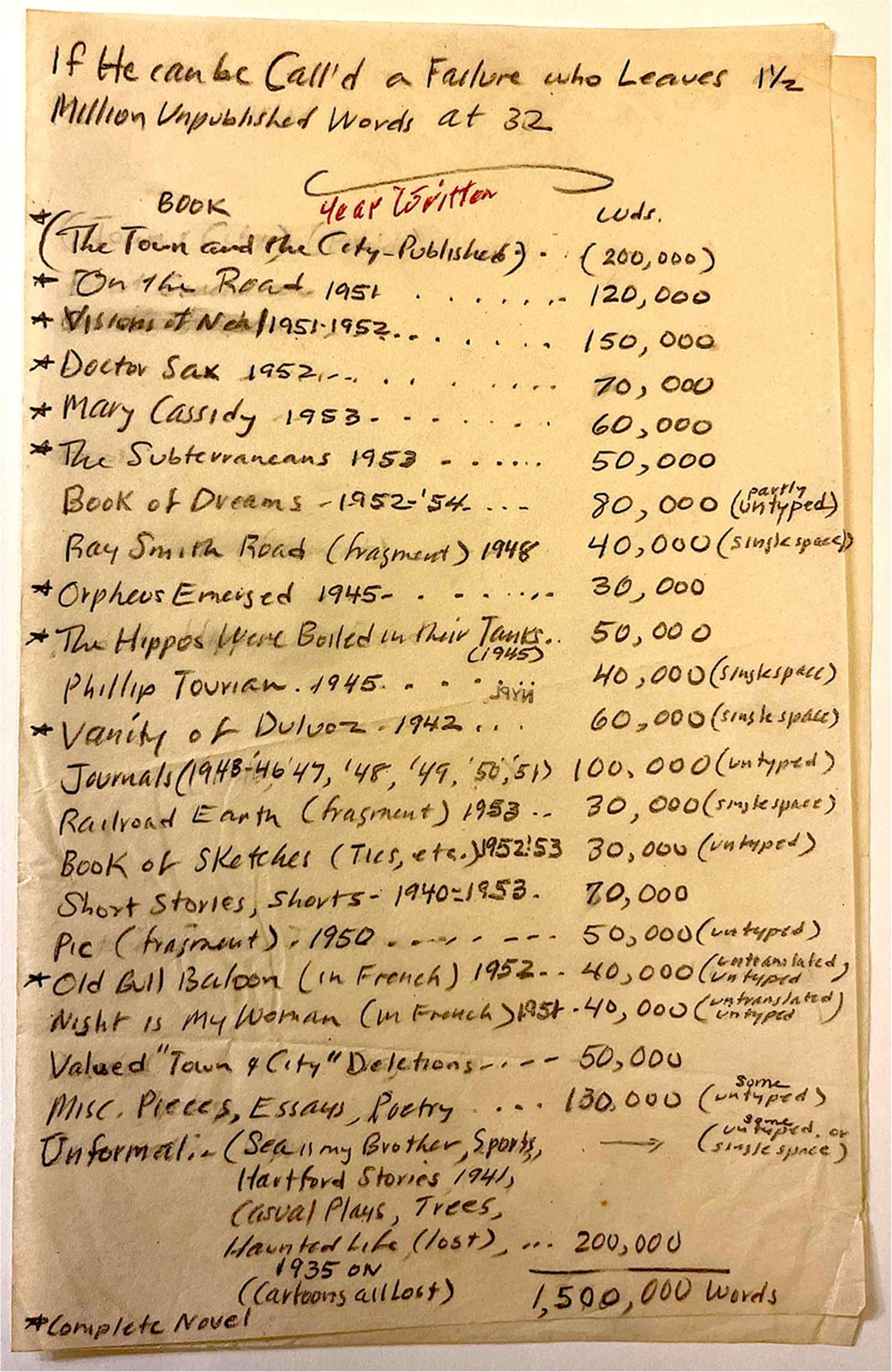
In 1954, at the age of thirty-two, Jack Kerouac had already written the bulk of his oeuvre though the vast majority of it remained unpublished. On a loose notebook page, he decided to list the titles of all the ‘books’ he had written in the time that he had lived thus far – the list has three columns: ‘Book’ (title or texts in question), ‘Year Written’, and ‘Words’ (approximate word count) – but he also adds parenthetical notes next to some of the entries. He called this list: ‘If He can be Call’d a Failure who Leaves 1½ Million Unpublished Words at 32’ (see Figure 1 and transcription below). His word count actually adds up to 1,470,000 words but he rounds up to 1.5 million – indeed, when compared with the later published versions of the books in question, his word count overall is a tad exaggerated. Nevertheless, it is an undeniably impressive number of words.
The document is valuable on multiple levels – a living snapshot of pre-fame 1954 Kerouac, a kind of privileged window into the author’s knowledge of his extant literary output, just as its title hints at his own insecurities as a writer. It is a stark and necessary reminder – especially since Kerouac has become so ingrained in the global popular imagination as a successful, freewheeling writer – that the novel that would propel him into bestselling fame, On the Road, was not published until 1957. Kerouac had toiled in obscurity for years, accumulating manuscript upon manuscript, draft upon draft, record upon record. When literary success came, three years after composing this list, he was able to provide publishers with a steady supply of book after book simply by returning to the archive he had been building since his childhood days creating fake newspapers in his bedroom.1 1962’s Big Sur was only the second ‘new’ novel he wrote in the wake of On the Road’s publication and its subject matter directly addressed the damage that this fame – the result of releasing a million published words – had wrought upon him and his diminishing ability to keep writing.2 The final line of Big Sur is, after all, ‘There’s no need to say another word’ (2015, p. 713).
The titles of individual works on the list can vary from the ones eventually used in later publication – ‘Mary Cassidy’, for instance, will appear as Maggie Cassidy in 1959; ‘Visions of Neal’ becomes Visions of Cody (though it had originally been called On the Road). That particular novel’s textual history is quite complex, as I’ll address in this essay. It first appeared in expurgated form in 1959 in a New Directions edition and then as a full novel posthumously released in 1972 by McGraw-Hill, but its manuscript manifestations underwent many changes over the years. Returning to the list, it further acts as an inventory of works that Kerouac considered distinct and that had yet to be published even at the time of his death in 1969. As such, the document serves as a kind of spectral guide to future literary ‘discoveries’ to be found within the author’s archive – and thus speaks not to the pitfalls but to the posthumous power of a life spent keeping ‘the neatest records you ever saw’, as Kerouac described his own papers in 1966 to Ann Charters, the scholar who was then compiling his bibliography and who would go on to be his first biographer with 1973’s Kerouac: A Biography (Kerouac, 1999, p. 424).
The following works from the list were published within his lifetime: On the Road (Viking, 1957; written 1951, revised several times), The Subterraneans (Grove Press, 1958; written 1953), Doctor Sax (Grove Press, 1959; written 1952), Maggie Cassidy (1959; written 1953), Book of Dreams (1960; written 1952–60). Those published posthumously are: Pic (1971; written 1951 and 1969), Visions of Cody (1972; written 1951–52), Atop an Underwood (1999; written 1936–43), Orpheus Emerged (2000; written 1944–45), Book of Sketches (2006; written 1952–57), And the Hippos Were Boiled in their Tanks (2008; written 1945), The Sea is My Brother (2011; written 1942), The Haunted Life (2014; written 1944), many of his journals were published in Windblown World: The Journals of Jack Kerouac (1947–54) and ‘Journal 1951’ appears in The Unknown Kerouac. A significant amount of Kerouac’s correspondence has also been published: Dear Carolyn: Letters to Carolyn Cassady (1983), The Selected Letters of Jack Kerouac (1995–99), Door Wide Open (2000), Jack Kerouac and Allen Ginsberg: The Letters (2011), ‘Letters from Jack Kerouac to Ed White, 1947–68’ in a 1994 special issue of The Missouri Review, and more. To my knowledge, only Ray Smith Road, Phillip Tourian,Vanity of Duluoz – the 1942 version listed here, not the 1968 novel of the same name – Hartford Stories, and possibly some of the shorter pieces alluded to on this list, have not yet been published.3
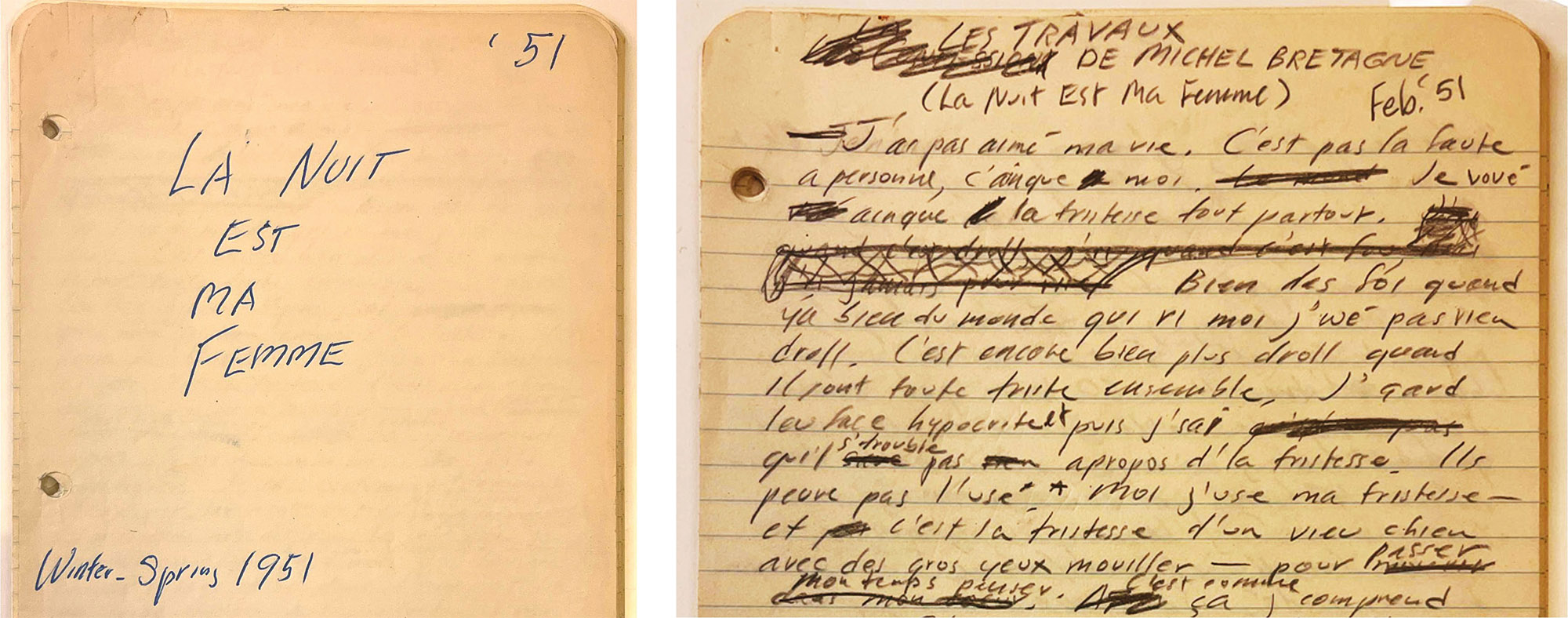
Of particular interest to me are the two books Kerouac lists as ‘(in French)’ and ‘(untranslated, untyped)’: ‘Old Bull Baloon’ and ‘Night is My Woman’. These two entries bring this document into the extremely small group of textual evidence that Kerouac also wrote in French and therefore proved useful to the editorial work I did to gather and publish Kerouac’s French writings in 2016. That year marked the culmination of a long process of archival sleuthing, transcription, and textual reconstruction spent in the Jack Kerouac Papers with the publication of La vie est d’hommage, a volume assembling the previously unpublished French writings of Kerouac, and of my translation into English of his two French novels, La nuit est ma femme and Sur le chemin in The Unknown Kerouac: Rare, Unpublished & Newly Translated Writings (Kerouac, 2016b; 2016a). These two short novels are precisely those Kerouac refers to in the 1954 inventory. ‘Old Bull Baloon’ is one of the protagonists of Sur le chemin, a text composed in December 1952, in Mexico City, that Kerouac eventually titled, ‘On the Road: Old Bull in the Bowery’. And ‘Night is My Woman’ refers to Kerouac’s first sustained effort at writing in Canuck French, ‘La nuit est ma femme, ou Les travaux de Michel Bretagne’, handwritten in February–March 1951. Those familiar with the now-legendary history of the composition of the On the Road (OTR) scroll will note the temporal proximity of La nuit est ma femme to the scroll: written back-to-back at the same desk in the Chelsea neighbourhood of Manhattan, the French novella is the last thing Kerouac completed before embarking on the three-week typing marathon that produced the OTR scroll in April 1951. As Joyce Johnson has suggested, writing in his mother tongue seemed to have recalibrated his voice, allowed him to come to English through his native French (2012, pp. 389–90).
As I noted, both the original French manuscripts and their English translations were published in 2016, and thus a decade after the 2006 opening of the Jack Kerouac Papers, part of the Berg Collection of the New York Public Library. Released within a few months of each other, these two volumes at last proved to the reading public that Kerouac was not only a native French speaker but also a French writer. This delay followed an imperfect itinerary caused by a series of multiple factors, not the least of which was the fact that the full manuscript to Kerouac’s longest French text, Sur le chemin, was scattered across several files in the Jack Kerouac Papers and had never been fully consolidated, even by its author. And yet, the meandering path I burrowed to reconstruct Sur le chemin became rather salutary as it led to the discovery of additional French texts buried in other notebooks. Through a focus on the textual reconstitution of Sur le chemin, this essay ultimately demonstrates that the key to stitching together the full text was to grasp the minutia of Kerouac’s compositional practices in 1951–52.
*
Perhaps more than anything else, the opening of Kerouac’s Papers in 2006 demonstrated the depth of the writer’s careful craftsmanship – how much he revised, moved and removed, edited and reinserted, abandoned and resurrected, so many chunks of prose across a wide expanse of time and space, despite his famous self-mythologising claim to ‘no revisions’ in the ‘Essentials of Spontaneous Prose’ (1993, p. 70). Indeed, his archive yielded many major revelations: that he had carefully kept a written record of his life since early childhood, that he seriously tried his hand at painting, that he played a complex fantasy baseball card game of his own invention from age nine until the end of his life, and, of chief concern here, that he had ‘meticulously organized’ most of his own writings himself using an alphanumeric system of his own design and had secretly composed multiple narratives, most of them unfinished, exclusively in his native French (see Bandera et al., 2018; Gewirtz, 2001). All of this stands in stark contrast to the ossified myth of Kerouac as a freewheeling intoxicated nomad who never revised and only believed in ‘first thought best thought’.
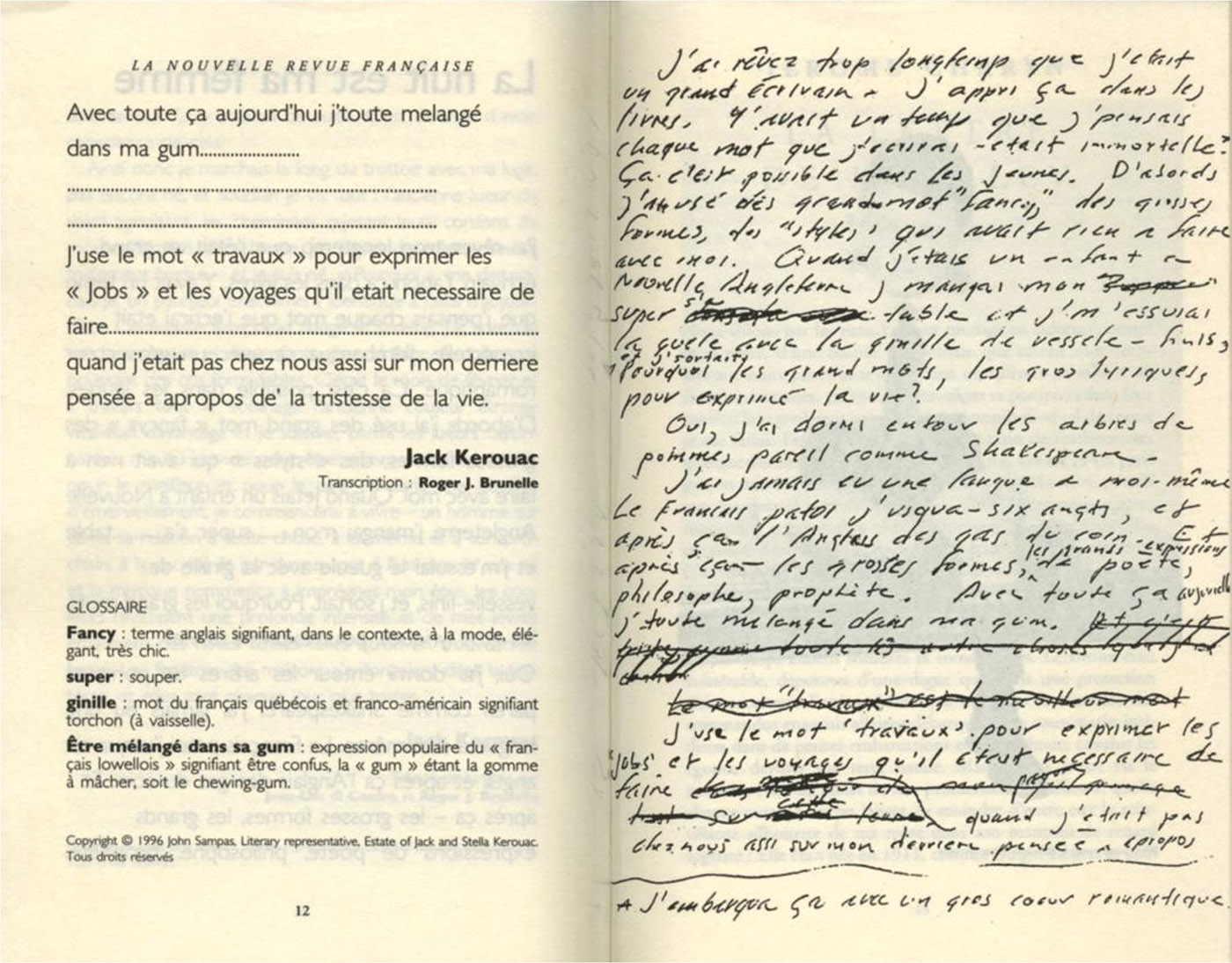
Kerouac’s alphanumeric cataloguing system consisted of four series, A to D, followed then by a varying number of files nestled within each series (e.g. ‘A1, f.1’, ‘D2, f.4’, etc.). It is in large part thanks to this careful conservation by the author that his nephew and then-literary executor, John Sampas, subsequently discovered many texts that would later be published posthumously.4 Sometime in the mid-1990s, Sampas noticed that some of the manuscripts Kerouac had kept were written in French, most prominently a 57-page story called ‘La nuit est ma femme’ in ‘D2, f.2’. The first page of the holograph manuscript has the title ‘Les travaux de Michel Bretagne (La nuit est ma femme)’ and is dated February–March 1951 (see Figures 2 & 3). Sampas, who could not decipher the text, asked a Franco-American Lowellian writer and teacher, Roger Brunelle, to do a rough translation of the text into English.5 A short time later, in June 1996, the Nouvelle Revue Française released an issue that included a brief excerpt from La nuit est ma femme (see Figure 4). The number included an interview with Brunelle, a short excerpt from the story – complete with a ‘Glossary’ to help explain unique French-Canadianisms – as well as a facsimile of a detail from a manuscript page.
Despite this revelation, no other publications from the French texts were released and, aside from a few whispers here and there by literary scholars in Québec and France, the fact that Kerouac had written in French seems to have been largely forgotten. This is in part due to the inaccessibility of the Kerouac archive at the time, which was kept locked away in a vault by Sampas who would only select specific scholars and editors for particular posthumous projects. For instance, Ann Charters was asked to publish the Selected Letters of Jack Kerouac, an indispensable collection whose first volume was released in 1995 and included letters related to the French texts that I’ll turn to later. The document that opens this essay, ‘If He can be Call’d a Failure who Leaves 1½ Million Unpublished Words at 32’, listing two texts ‘in French’, was reproduced in the November 1998 issue of The Atlantic Monthly for a piece by Douglas Brinkley entitled ‘In the Kerouac Archive’ (Brinkley, 1998). When the Estate struck a deal of sale with the New York Public Library (NYPL) in 2001, the contract further stipulated that Brinkley would be put in charge of writing the ‘authoritative’ biography of Kerouac. To that end, the purchasing agreement with NYPL required that an embargo would be in effect on the newly acquired Kerouac Archive for a period of five years. To be more precise, scholars would only be given access to the processed papers on 1 January 2006. Prior to that date, Brinkley was given sole access to the collection’s complete contents.6
Kerouac’s meticulous preservation of his archive suggests that he was hoping for the potential posthumous publication of the writings he left behind – indeed, in a passage from ‘Night is My Woman’, Kerouac prophesises the eventual plundering of his archive by future scholars:
I’m supposed to be a writer. I published a book, I received $1900.00 for 4 years of work on that book. Before that I spent 10 years writing other things that I was never able to sell. It’s possible that one day, once I have gone over to the other side of the darkness to dream eternally, these things, stories, scenes, notes, a dozen impossible novels, half finished, will be published and someone will collect the money that was supposed to come to me. But that’s if I am a great writer before I die. [2016a, pp. 65–66]7
The great writer’s careful cataloguing system did eventually guide future hands to find these ‘half finished’ ‘stories, scenes, notes’ and ‘impossible novels’, but scholars – and this is a crucial point – were further aided by the invaluable work of the custodians of the Jack Kerouac Papers in the Berg Collection.
*
The Jack Kerouac Papers finding aid was composed by Declan Kiely, who subsequently served for a decade as a Curator at New York’s Morgan Library, returned to the New York Public Library in 2017 as the director of Special Collections and Exhibitions, and is now the Executive Director of The Grolier Club.8 Back in the early 2000s, Kiely was the archivist put in charge of processing the Kerouac collection and I consider his work to be an exemplar of meticulous description and clarity in a literary finding aid. It is largely thanks to Kiely’s masterful handling of the materials, as well as his detailed finding aid, that researchers were later able to find many of the French manuscripts. Kiely arranged the writings series in two large categories: ‘Jack Kerouac’s arrangement of his archive’ and the rest, ‘Writings by Jack Kerouac (not arranged by Kerouac in an alphanumeric system)’. This respect des fonds alone is an ongoing gift to future Kerouac scholarship that gives us a tremendous amount of information into Kerouac’s classification practices and writerly craft. As Kiely processed the voluminous materials, he made a point of noting whenever he encountered French, even when this was only a small amount mixed in with the usual English prose. He then indicated its presence in the container list, as these examples show (my emphasis):
2.43
Holograph fragment ‘On The Road’ with note in French on verso of first leaf, March 23, 1951.
3.38
Holograph, untitled. (Begins: ‘Le plu vieux des fils, Joseph...’) Fragment in French-Canadian, 1954.
6.4
Holograph story, signed. ‘Search by Night’. (Dialogue in French Canadian. ‘Searching for the eye of the war’; written just after Pearl Harbor, set in New England mill town.) December, 194.
13.3
Typescript, in French. ‘Commentaire sur Louis-Ferdinand Celine’. 1962.
13.42
Holograph notes “Nanda.” (Includes French phrases and expressions.)
As a general rule, Kiely’s entries have an exceptional level of detail – this depth of information at the ‘item level’, as archivists put it, is unfortunately more and more uncommon in literary finding aids. The efforts needed to incorporate such details are often prohibitively time-consuming and quite expensive. As a result, item-level processing of this kind is usually reserved only for collections that are assigned the highest ‘research value rating’, and are often a luxury only major repositories can afford.
As a result of the care taken by Kiely, the researcher interested in Kerouac’s French-Canadian writings can systematically locate each entry that has been marked as such in the finding aid. Even beyond this interest, thanks to the preservation of Kerouac’s original arrangement, the finding aid itself becomes an incredibly informative, and even illuminating, document regarding Kerouac’s oeuvre as a whole; it provides a starkly different portrait of the writer than most popular accounts – indeed, this finding aid could be exhibit A in proving how misunderstood and misread Kerouac has often been. And yet, despite its thoroughness, the Kerouac finding aid does not list every French manuscript lurking within the Kerouac Archive. This is not a failing of the instrument, however, but an inevitable reality of the archival profession. Finding aids are often deceiving in this way; even those representing years of colossal labour, composed with as much meticulous care as Kiely’s, are ‘incomplete’. Indeed, to imagine a ‘complete’ finding aid would amount to something like a Borgesian ‘Pierre Menard’-like duplication, in full, of every single listed item – as such, it would cease to be a finding ‘aid’ and become an impractical facsimile of the thing itself. The map is not the territory, as they say.
Barring a few omissions, the Kerouac finding aid does list the bulk of Kerouac’s French writings – this is in part due to Kerouac’s own arrangement established prior to acquisition. Although Kiely’s finding aid uses a new classification system, it still provides where each file used to be kept according to Kerouac’s old alphanumeric record keeping. For instance, ‘La nuit est ma femme’ is now in Box 15, Folder 20 at the Berg, but the container list indicates that it used to be housed in ‘D2, f2’. (Series D2, Folder 2 refers to Kerouac’s system.) Such a respect des fonds made it possible to undertake an overview of where Kerouac had filed most of his French writings. As it turns out, the French writings – and his writings prominently featuring French Canadian characters – were largely housed in Series A and D, including the short stories ‘On the Road écrit en français’, ‘L’ouvrage de ma vie’, ‘Écoutez le monde’, ‘Bop blow bop’, ‘Quand tu rencontre un homme supérieur’, ‘Le plu vieux des fils, Joseph…’, and the mind‑blowing, ‘Je suis tu capable d’écrire avec mon doigt bleu?’. These series also housed non-fictional French pieces like, ‘Sé dur pour mué parlé l’Angla’, and his letters to his aunt Louise Michaud and his mother Gabrielle. Missing from either Series A or D – indeed, missing from the entire Series 1 ‘Jack Kerouac’s arrangement of his archive’ – is the longest one of them all, Sur le chemin. To find this novel, a more complex path had to be undertaken.
*
The best point of departure to find Sur le chemin is the only document – as far as I know – in which Kerouac directly reveals that he has just written a novel in French. In a January 1953 letter to his friend and muse Neal Cassady, Kerouac writes:
In Mexico, after you left, I in 5 days wrote, in French, a novel about me and you when we was kids in 1935 meeting in Chinatown with Uncle Bill Balloon, your father and my father and some sexy blondes in a bedroom with a French Canadian rake and an old Model T. You’ll read it in print someday and laugh. It’s the solution to the ‘On the Road’ plots all of em and I will hand it in soon as I finish translating and typing. [1995, p. 395]
This letter, first published in 1995’s Selected Letters: 1940–1956, edited by Charters, also provides crucial wider context for the compositional history of Sur le chemin – not to mention positioning this French novel as ‘the solution to the “On the Road” plots all of em’, an important statement I’ll return to in the conclusion.
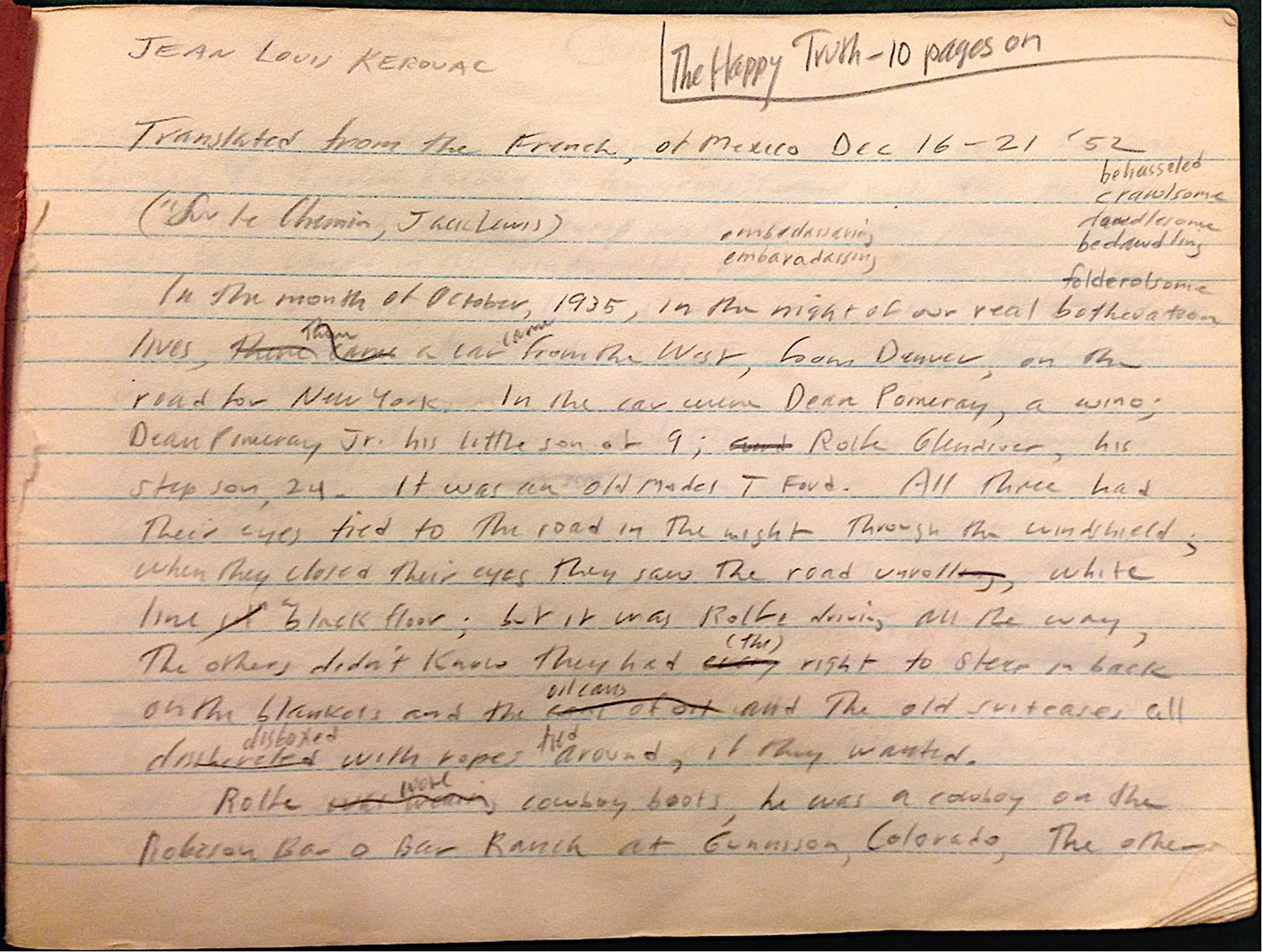
The letter also specifies that Cassady will be able to ‘read it in print someday’ only after Kerouac has ‘finish[ed] translating and typing’ the manuscript. Alas, this is a task he never fully completed, even though his archive does preserve some of his attempts at translating the novel – in one such notebook, he signs: ‘Jean-Louis Kerouac, Translated from the French, of Mexico…’, and completes roughly ten pages of handwritten translation into English (see Figure 5). Kiely does not make a direct link to Sur le chemin in the finding aid but he does include the line, ‘Translated from the French’ in the container list – thereby flagging it for scholars seeking to find French-related materials.
Further scrutiny of the finding aid does yield an item with ‘Sur le chemin’ in the folder title (my emphasis):
39.10.
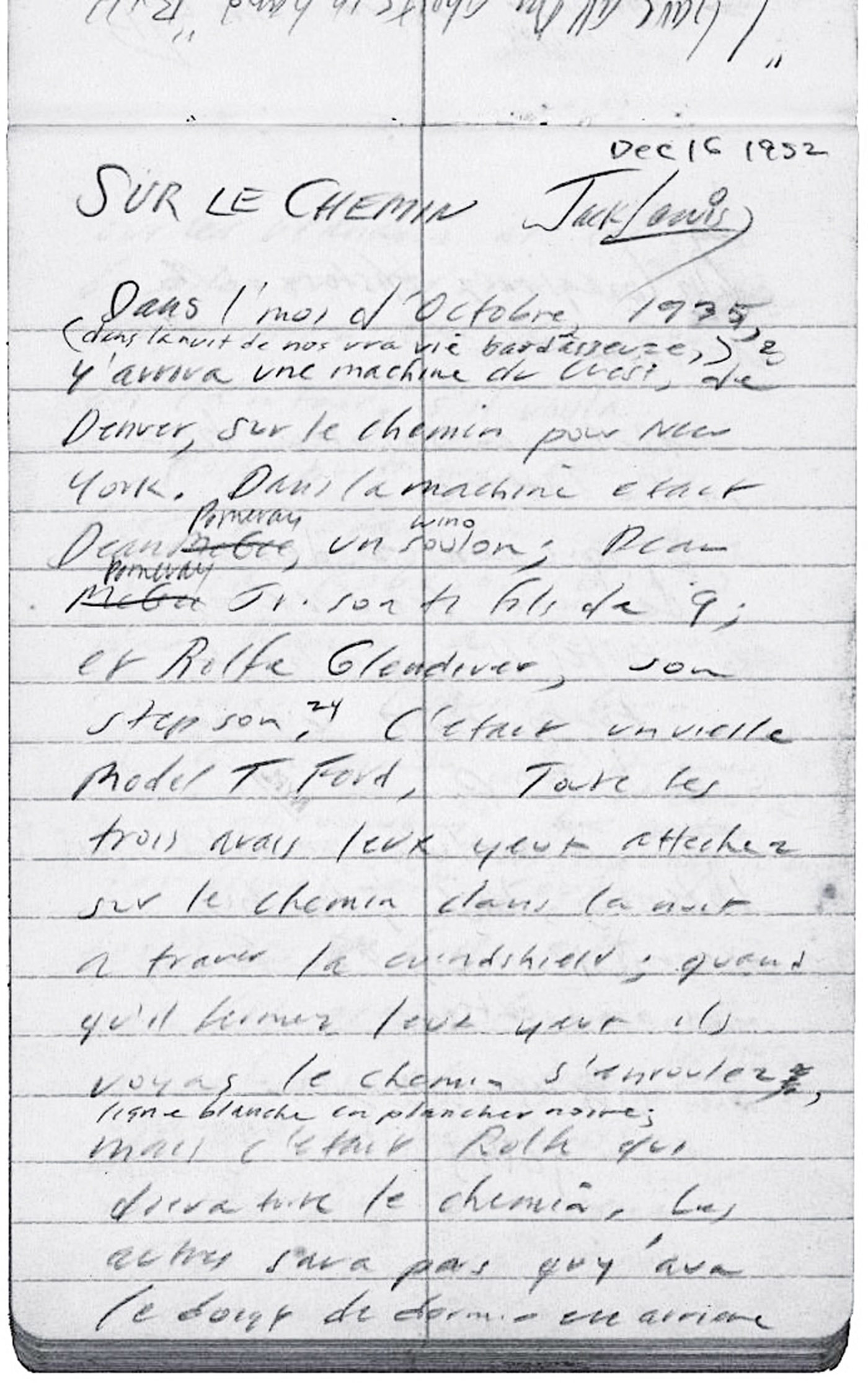
Holograph notebook ‘Old Bull’. Includes ‘On the Road by Jack Lewis’, and ‘Sur Le Chemin – Jack Lewis Dec. 16, 1952’, and ‘Workbook Mexicay’. 5 Laid-in leaves of ‘On the Road Dec. 26’ (paginated 1–4) and a fragment note, untitled and unpaginated.
The notebook in 39.10 includes the beginning of Sur le chemin – and roughly 35% of the entire novel can be found in this notebook (see Figure 6).
Five folders earlier in the finding aid, one finds the following item listed:
39.5
Holograph notebook ‘French “Old Bull in Bowery”’ and ‘On the Road’. ‘On the Road’ notebook, including one page cartoon (40 leaves).
It is in this notebook, labelled ‘French “Old Bull in Bowery”’, that the novel begun in notebook 39.10 resumes. Again, this notebook consists of roughly another 35% of the total novel. You will note that the finding aid does not indicate that these notebooks are two parts of the same text. This is largely due to the fact that to follow this manuscript takes a special knowledge of French – Kerouac’s singular Canuck French, which closely resembles Québécois French, sometimes referred to as joual. Only extensive research would allow a scholar to ascertain that ‘French Old Bull’ is just another way of referring to Sur le chemin for Kerouac – without this added knowledge, there is no reason to bring these two separate notebooks together – hence their slight distance from each other in the intellectual arrangement of the finding aid. Nevertheless, even by reuniting, so to speak, the two main Sur le chemin notebooks, the full manuscript remains incomplete – roughly 25–30% is still missing. This was not immediately apparent but rather came as a slow realisation during the complicated process of transcription: in other words, the manuscript called for the insertion of various fragments that could not be located within these two notebooks alone; they had to be found elsewhere.
The other key document that proved invaluable to accurately tracking the novel’s integrity was one of Kerouac’s own partial translations of Sur le chemin – a typescript he had filed in D1, F.3, and listed as:
Typescript, revised. ‘On the Road – Old Bull in the Bowery (1952, Mexico City) [Written in French patoi]’. Features characters ‘Dean Pomeray, Uncle Bull Balloon, Little Neal/Cody Deaver, Rolfe Glendiver, Leo Duluoz, Ti Jean’, and ‘Pictorial Review Jackson 1952 (43 leaves; [Inventory states 51 leaves.]) D1, f.3.
The amount of detail in this entry provided by Kiely is astounding. Anyone familiar with Sur le chemin would immediately recognise the cluster of characters here but would also be pulled in by the ‘Written in French patoi’ note. The note is actually a quote that Kerouac inscribed on the bottom of this typescript’s title page – and the title he gave to his 1954 translation, ‘On the Road: Old Bull in the Bowery’, further becomes a direct call back to the notebook in 39.5 called, ‘French Old Bull in the Bowery’. Taken together, this piece of the puzzle further helps us understand why, in his 1954 inventory, ‘If he can be Call’d a Failure’, he refers to Sur le chemin as ‘Old Bull Baloon’. With these pieces now assembled, the true work of transcription and consolidation could begin.
*
Transcribing the novel proved a challenging task, not only due to the idiosyncratic nature of Kerouac’s ‘sound-spelling’ approach to capturing his native French Canuck language into written form – Kerouac essentially invented ‘uneoralité qui n’avait pas encore trouvé ses lois de scripturalité’ (‘an orality that had not yet found its laws of scripturality’), to quote Édouard Glissant – but also due to the abundance of scattered inserts, fragments that had to be located and ordered correctly (2010, p. 23, my translation). Consolidation required an intimate understanding of Kerouac’s compositional practices in the early 1950s – and how these, as a rule, involved ‘inserts’. Kerouac initially writes almost everything by hand in notebooks. He then later groups the holograph notebooks containing specific drafts into bundles that he ties with an elastic band before storing them. His preferred kind of notebook has the spine at the top rather than on the left, allowing him to flip the pages upward as he writes. With his first pass, Kerouac only writes on the bottom sheet. He leaves the upper page (the verso of the previous page) empty in case he wants to add something on the fly – what he calls ‘insertions’ in ‘The Essentials of Spontaneous Prose’: ‘no revisions (except obvious rational mistakes, such as names or calculated insertions in act of not writing but inserting)’ (1993, p. 70). The idea of ‘revision’ is too antithetical to that of ‘spontaneous prose’, so inserts are the closest thing Kerouac will allow. I should add that inserts aren’t usually added at some later date; they come in the midst of initial composition.
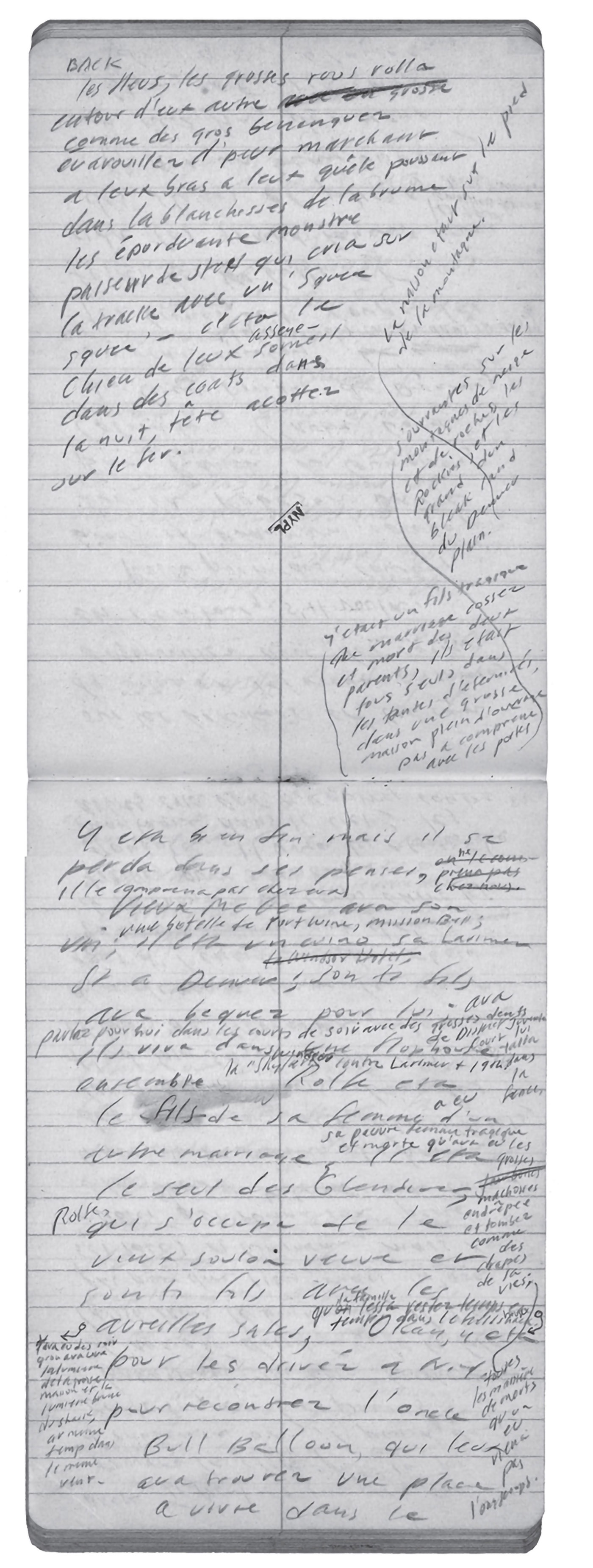
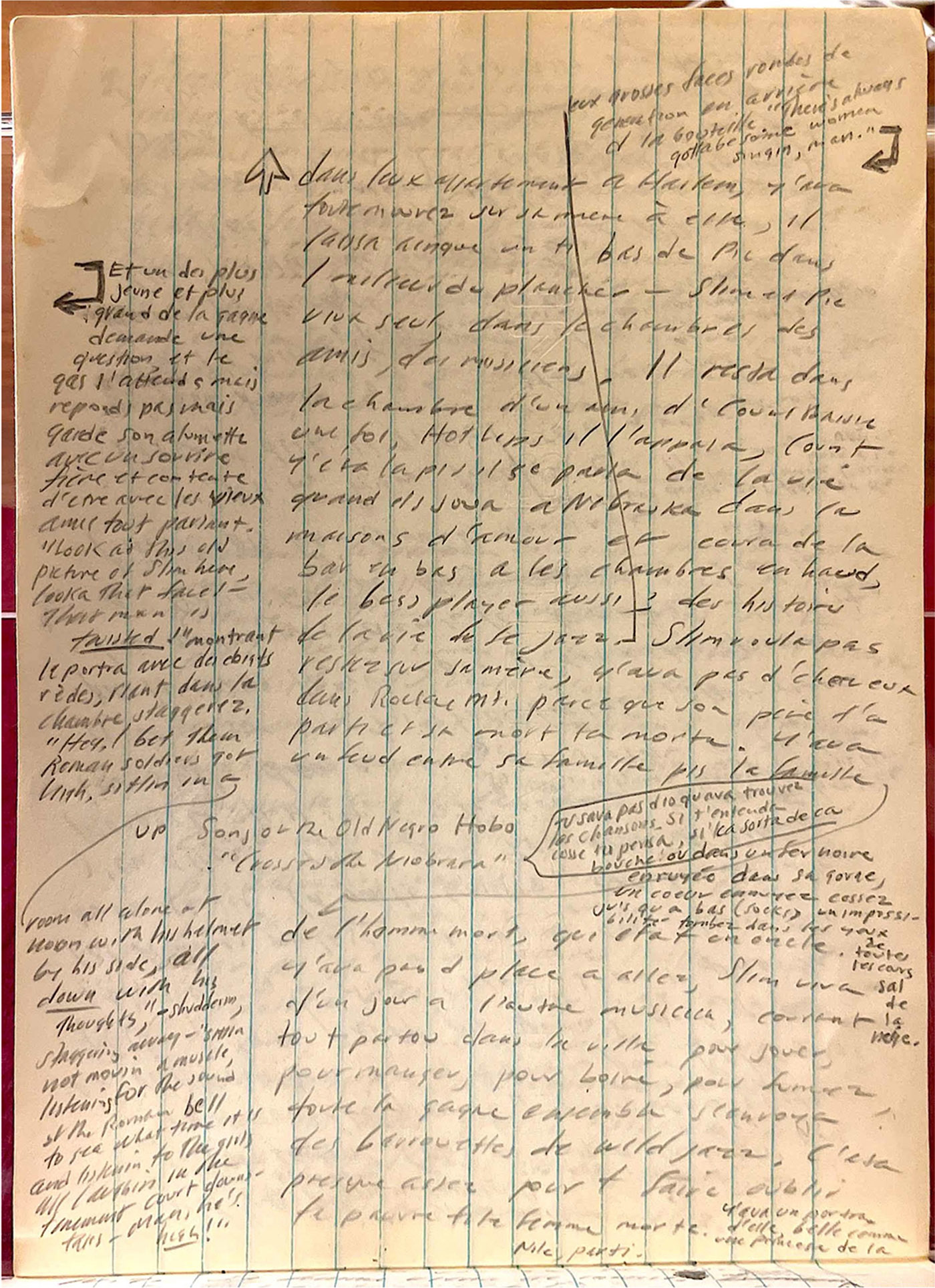
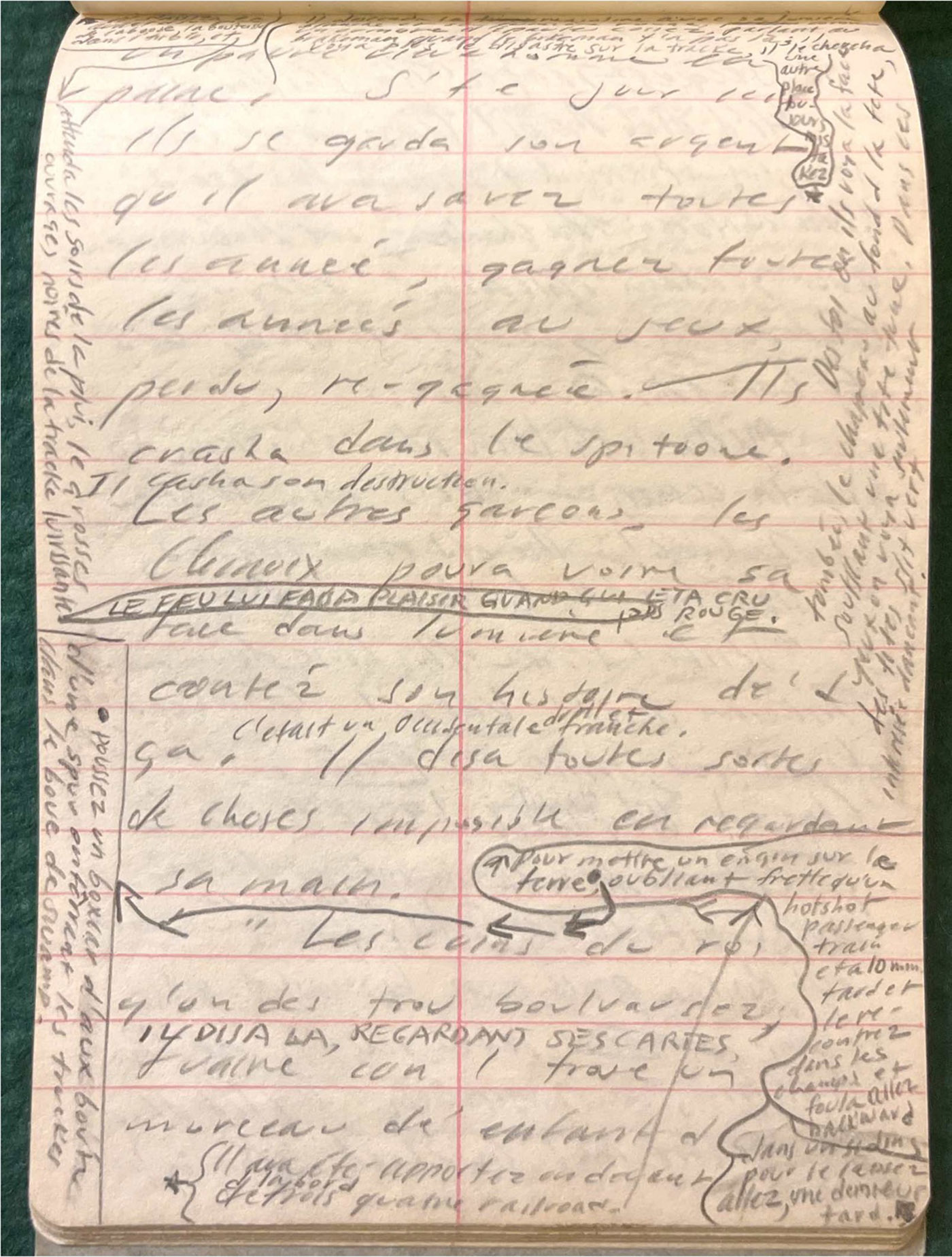
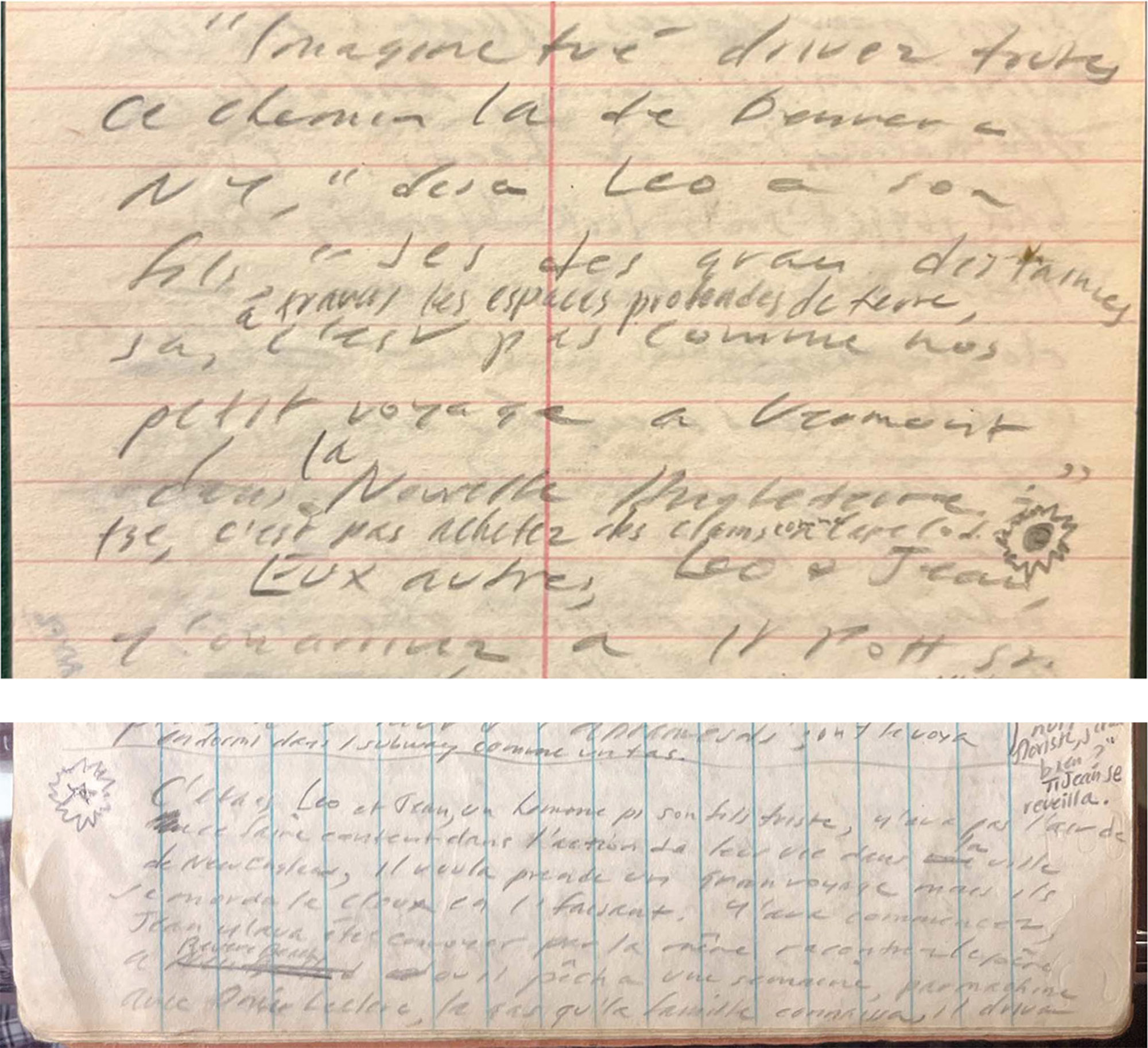
The simplest kinds of Kerouacian inserts are usually a line that tethers a given insert to the spot where it should be wedged (see Figure 7). The tethered insert can itself be tethered to another insert – as in Figures 7 (‘BACK’) and 8 (various arrows and ‘UP’) – the flip notebook format is ideal for this kind of compositional habit. When a given page runs out of space, he resorts to a system of capitalised words, like ‘BACK’ at the top, or various geometric shapes, to differentiate them and make sense of things when the time comes for the typewriting phase. All of this is done in preconceived anticipation of the typewriting – and translating – phase to come.
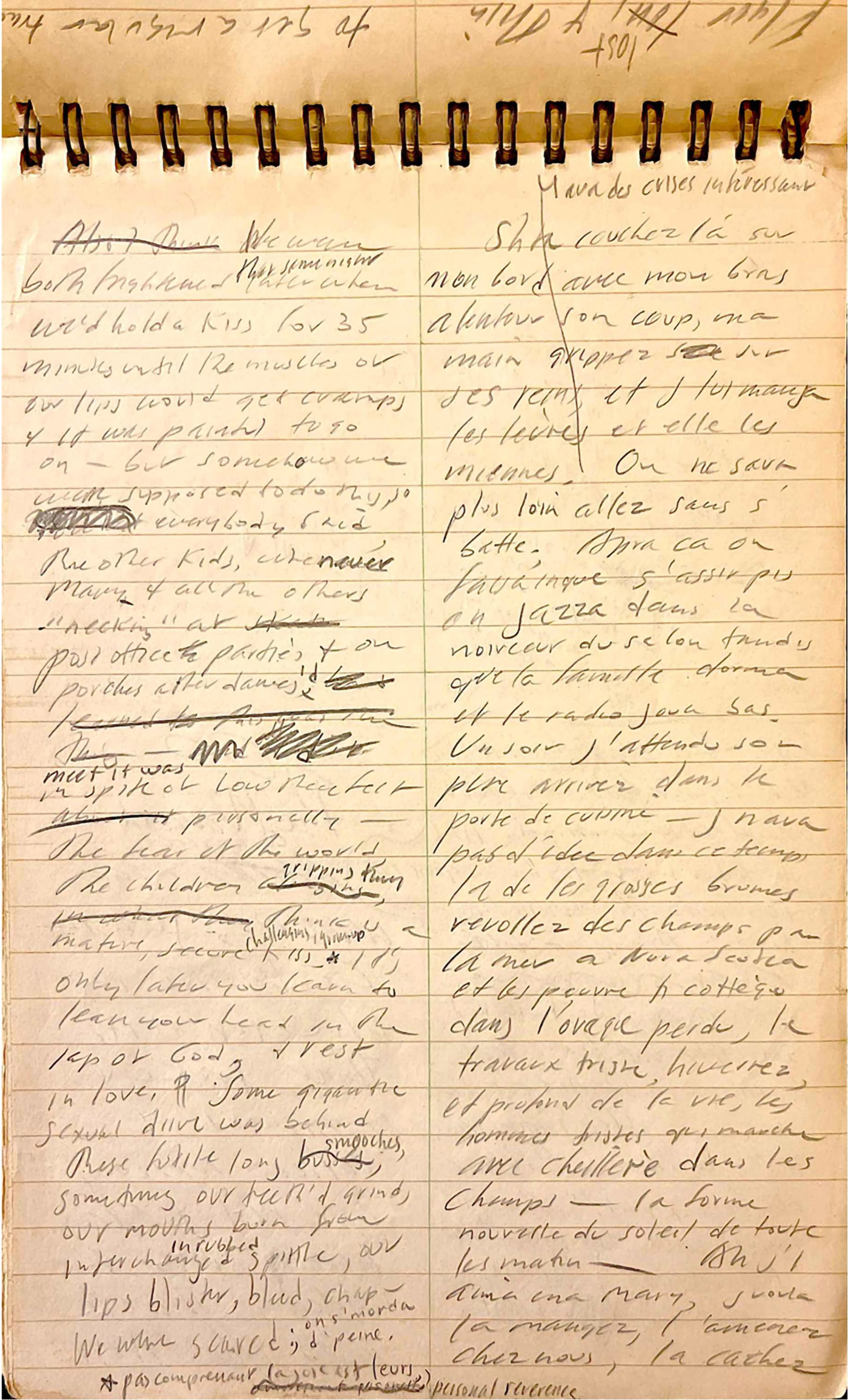
Common insert-symbols like UP or BACK are always capitalised – to distinguish them from the narrative – and are literal directions, meaning that you have to flip the notebook up or back one page to find the right fragment. The symbols range from differently shaped arrows (pointing left, right, up, down, bifurcating, or one is thin, or hollowed out, etc.) to circles, squares, rectangles, and stars. Figure 8 shows a notebook page crammed with multiple arrow inserts, tethering lines, and one ‘UP’.
What made this uneven itinerary even more maddening was the Berg Collection policy that restricted researchers to requesting only a single item at a time (as opposed to a whole box with multiple folders). Thus, each insert whose match was in a different notebook entailed a significant wait time.
On a few occasions, a given insert’s match could not be found within the core matrix of the two main notebooks (39.5 and 39.10), which led to a delay in my progress. Knowing that Sur le chemin was composed in December 1952, I began systematically requesting other notebooks from that year, as well as some from early 1953. This was time-consuming but fruitful in more ways than one: not only did I locate some of the stray insert sections, but I also uncovered quite a few more French texts that had not been flagged on the finding aid. All of these were later included in La vie est d’hommage. A particular standout from this harvest is ‘Je suis tu capable d’écrire avec mon doigt bleu?’, an unfinished story that recounts a hitchhiking trip Kerouac undertook in 1952, in which he attempts to recreate a portion of a 1947 trip he recorded in On the Road, but finds that the American landscape has already been profoundly altered: the narrator laments the rampant materialism on display, odiously ostentatious couples in big cars, children growing more obese with each encounter, and an increasing number of trucks with a ‘No Riders’ sign clamping down on hitchhiking culture (JKP, Box 30, Folder 8). After discovering ‘mon doigt bleu’, I alerted the Berg conservator and asked that they add this detail to the finding aid in order to flag it for future researchers interested in Kerouac’s French writings; today, the container list for Box 30, Folder 8, reads (my emphasis):
Holograph notebook [Memorandum Book] “6.” (Begins: “VOYAGE (cont'd from bk. 6) / The fellow with his arms around the world.”) [“Visions of Cody.”]; and with an unfinished short story written in French, introduced with line: “Je suis tu capable d’écrire avec mon doigt bleu?” [“Am I able to write with my blue finger?”].
Another major find was the discovery that large sections of the manuscript for the novel Maggie Cassidy – namely Chapters 7 to 10, 20 to 21, 27, and 37 to 41 – were originally composed in French. Figure 12 shows the first time the narrative suddenly switches from English to French – in the novel, this is the moment when the narrator, a French Canadian, shares his first kiss with Maggie Cassidy, an Irish-American Lowell girl. Perhaps the intimacy of this moment organically led Kerouac to recount this impassioned scene in his mother tongue.
Although these discoveries were thrilling, reconstituting the entirety of Sur le chemin remained elusive. Eventually, there came a time when I had successfully stitched and transcribed everything except four distinct kinds of inserts whose match could not be found in any 1951–1952 notebooks. The missing inserts were:
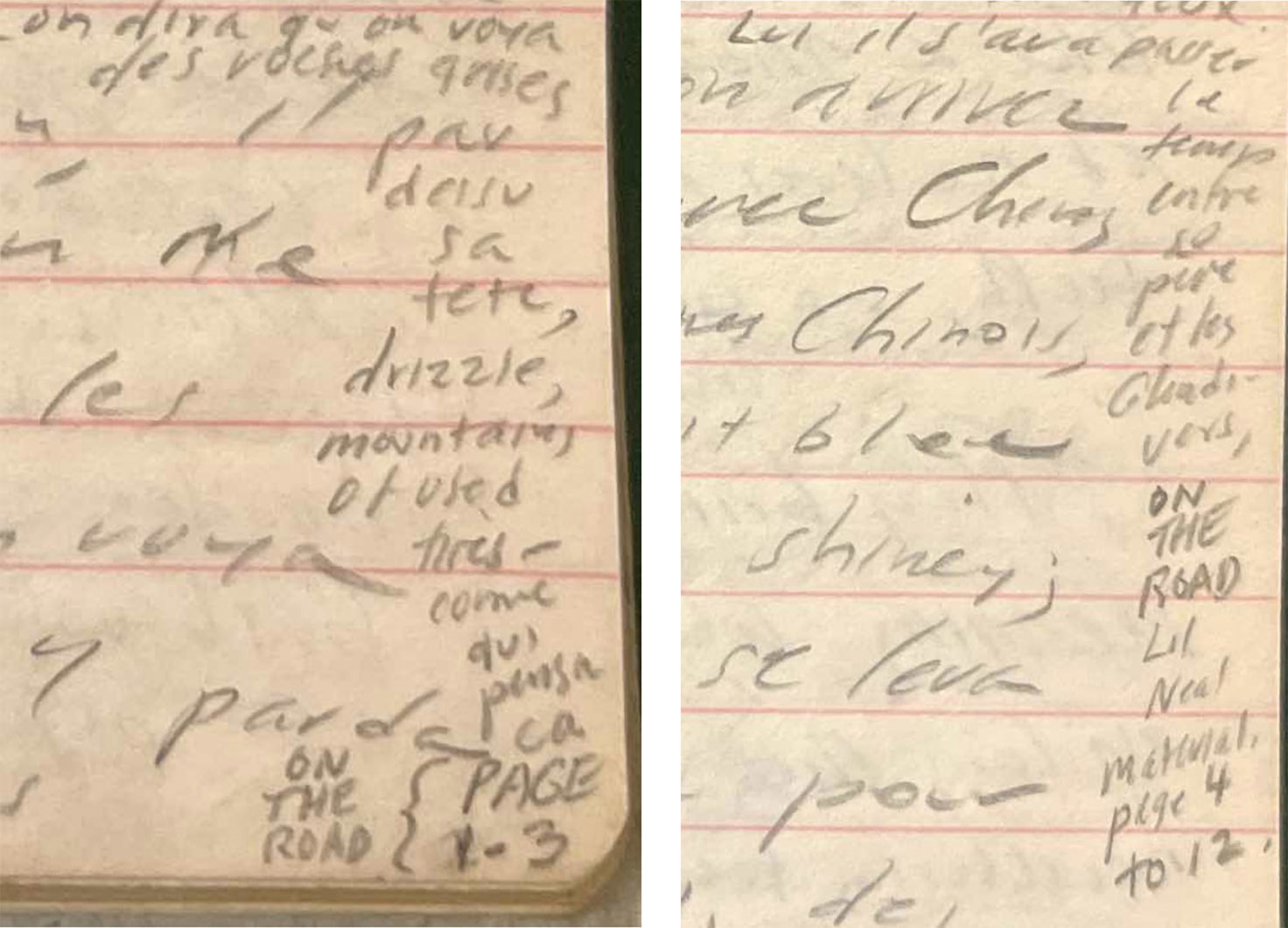
‘ON THE ROAD Lil Neal Material page 4 to 12’;
‘ON THE ROAD PAGE 1–3’;
‘Material of Ha? Neal?’;
‘FROM LEO DULUOZ TO RUEFUL GHOSTS – THEN BACK ONE PAGE’.
These four were distinct because they were written out; they looked almost like instructions or labels, rather than consisting of the usual symbols or shapes (see Figures 13, 14 & 15).
Although the two labelled ‘ON THE ROAD’ may seem straightforward, their locations were in fact initially confounding. The reason for this has to do with the complicated composition history of On the Road. Or rather, with the history of the multiple texts that Kerouac referred to as ‘On the Road’ in the late 1940s and early 1950s.
As I explained, Sur le chemin was written in mid-December 1952, and throughout most of 1951 and 1952, Kerouac labelled many of his working drafts as ‘On the Road’. When the now famous On the Road scroll, typed up in April 1951, was rejected by publishers, Kerouac set it aside in favour of even more experimental prose, but still wanted his next book, whatever it may be, to bear the title ‘On the Road’. He even wrote an aborted French manuscript called ‘On the Road Écrit en Français’ – yet my hopes that this text held the missing Sur le chemin pieces were quickly dashed as it was clearly a separate story (JKP, Box 2, Folder 41). The key was to figure out which text Kerouac was calling ‘On the Road’ in December 1952. As I often did during the transcription process, I returned again to Kerouac’s own partial English translation of Sur le chemin, the ‘On the Road: Old Bull in the Bowery’ typescript. This typescript corresponds to roughly 40% of the complete text and was an essential guide on multiple registers: not only did it help clarify what could sometimes remain nebulous in French Canuck, but it also provided a clear narrative chronology as a text that had already incorporated many of Kerouac’s manuscript inserts. Having been typed and translated by Kerouac himself, it confirmed, with precision, when a given insert was meant to enter the narrative flow. However, the typescript is incomplete in two ways: one, the pages stop after the one numbered 59, even though the novel is not over (as I knew from having read the ending in the French original); and two, there are gaps in the pagination. The extant pages are: 1–10 (11–19 are missing), 20–23 (24–32 are missing), 33–59 (60 and beyond are missing or never existed). Despite the three gaps, having this document at my side was as close as one could possibly get to having Kerouac himself look over the transcription and confirming that the narrative order was correct. Of course, after page 59, I was on my own.
Returning again to the typescript translation, I undertook one final process of verification and cross-checking back from typescript translation to French text, and this time something I had not noticed before emerged: the first principal gap in the typescript – pages 11–19 – corresponded precisely to the first of the ‘ON THE ROAD’ insert indicators for ‘Lil Neal Material page 4 to 12’. At this moment in the French notebook, roughly eight pages worth of material from ‘ON THE ROAD’ is supposed to be wedged in between the two paragraphs on the manuscript page. When you look at the corresponding typescript page of Kerouac’s translation, page 10, you see that Kerouac had access to the ‘missing’ insert because the typescript translation simply continues without a break. In the French notebook one encounters this:
Il ava presque l’air de son pere, mais seulement dains yeux. Lui il s’ava passer le temps entre son pere et les Glendivers, ON THE ROAD Lil Neal Material page 4 to 12.Ça c’eta des reves, la realité eta plus tendre. Son pere le laissa mettre les mains dans ses poches a lui, pour gardez chaud, dans l’même cote, il ria pis shivra ensemble. [JKP, Box 39, Folder 10]
In the matching typescript moment, one finds this at the bottom of page 10:
He almost looked like his father but only in the eyes. He had passed his time boyhood between his father and the Glendivers., It was only nine years before, in 1927, that Dean was born in Salt Lake City; at a time when for some God-forsaken reason, some forgotten pitiably American restless reason his father and mother were driving in a jaloppy from Iowa to L.A. in search of something, maybe they figured to start an orange grove to find a rich uncle, Dean himself never found out, a reason long buried in the sad heap of the night, a reason that nevertheless in 1927 caused them to fix their eyes anxiously and with throat-choking hope over [end of page]. [JKP, Box 15, Folder 4]
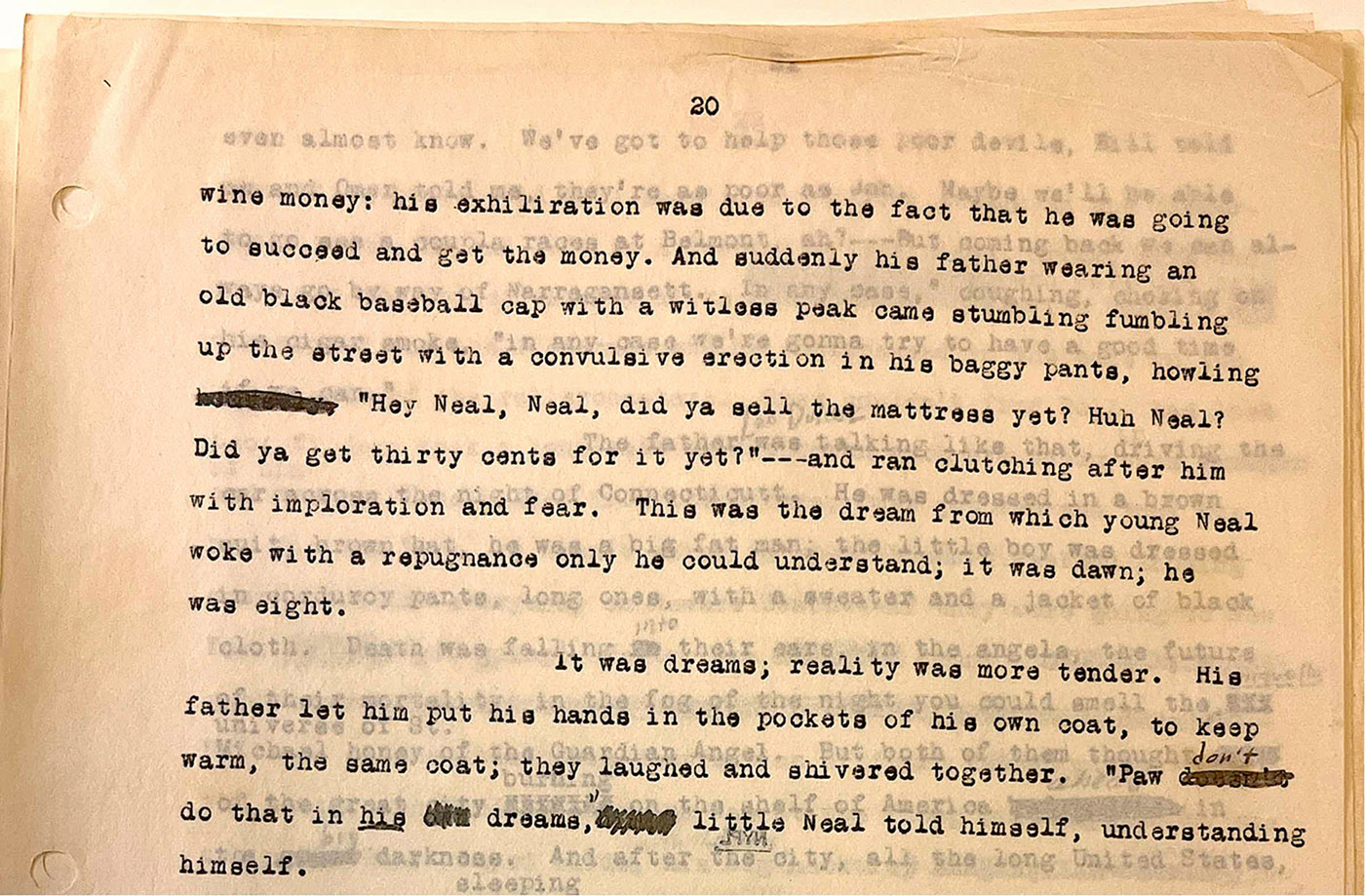
At this juncture, the typescript skips pages 11 through 19, and resumes on page 20. But as you can see, starting with ‘It was only nine years before…’ up to ‘throat-choking hope over’ must necessarily be taken from the ‘ON THE ROAD Lil Neal Material page 4 to 12’. Where the typescript resumes on page 20 includes the moment the French manuscript, quoted above, continues after the ‘ON THE ROAD’ insert indicator: ‘It was dreams; reality was more tender’ is the translation of the French line, ‘Ça c’eta des reves, la realité eta plus tendre’, that immediately follows the insert indicator (see Figure 16):
Therefore, the material at the top of page 20, before the paragraph break that resumes the French translation with ‘It was dreams […]’, must necessarily correspond to the tail end of the ‘ON THE ROAD Lil Neal Material page 4 to 12’ insert.
The exact same pattern of correspondences happens with the ‘ON THE ROAD PAGE 1–3’ insert. In the French manuscript, one finds:
Ons le voya en avant du Overall Store avec ses grand sideburns – on dira qu on voya des roches grises par dessu sa tete, drizzle, mountains of used tires – comme qui pensa ca. ON THE ROAD PAGE 1–3.Y’ava demandez une couple de question, il marsha slo. ‘Rien me baudra’, il disa. Ainque les belles filles. Y’en voya des milles passez. [JKP, Box 39, Folder 10]
And on the matching narrative moment in the typescript translation, on page 43, we find that the insert is here seamlessly integrated into the text after ‘comme qui pensa ca’ / ‘as if he was thinking it’:
You saw him in front of the overall store with the long sideburns – it seemed you could see gray rocks over his head, drizzle, mountains of used tires, as if he was thinking it. Have you ever seen anyone like Rolfe Glendiver? – say on a street-corner on a winter night in Chicago, Fargo, cold towns, a young guy with a bony face that looks like it’s been pressed against iron bars to get that dogged rocky look of suffering, perseverance, finally when you look closest, happy prim self-belief, with Western sideburns and big blue flirtatious eyes of an old maid and fluttering lashes. [JKP, Box 15, Folder 4]
The insert ends on the top of page 45 on the typescript, where the French translation seamlessly resumes with a new paragraph that begins: ‘Rolfe had asked a few questions; he was walking slow’, Kerouac’s translation of the original, ‘Y’ava demandez une couple de question, il marsha slo’.
This particular extended insert, which begins with ‘Have you ever seen anyone like Rolfe Glendiver’, stood out more than the others because it came with a sense of recognition: I had previously encountered a version of this passage in Visions of Cody. In the latter, however, the line reads, ‘Have you ever seen anyone like Cody Pomeray’, not Rolfe Glendiver – Cody being the Cassady character and the eponymous hero of the book. This genetic link between Sur le chemin and Visions of Cody turned out to be a major revelation that allowed everything to fall into place. I looked back at some of Kerouac’s correspondence from late 1952 and confirmed that, back in December of that year, when Kerouac composed Sur le chemin in five days, what he called ‘ON THE ROAD’ referred to the typescript that became Visions of Cody – the one listed as ‘Visions of Neal’ in the 1954 inventory page that opens this essay. To confirm that Sur le chemin incorporated, into its very composition, sections from the then freshly completed Visions of Cody, I returned to the Berg to request to see the behemoth typescript of the novel.
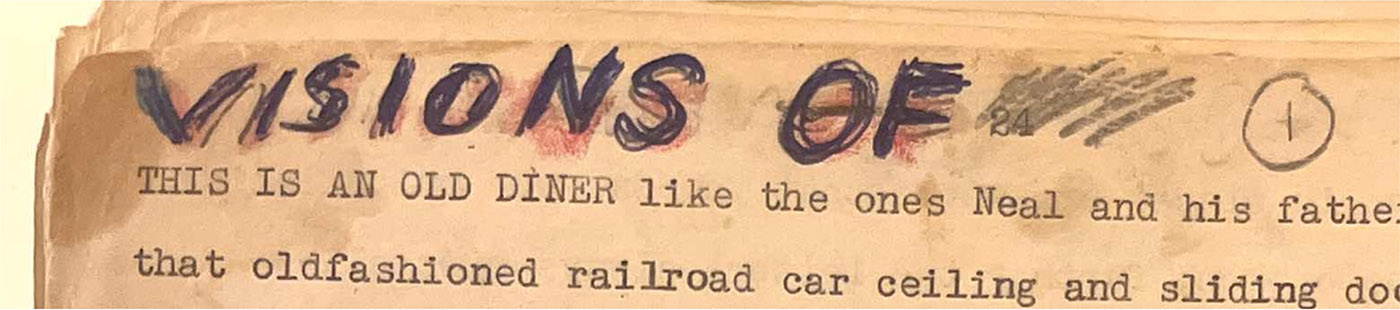
I was initially distressed when I realised that the typescript pagination did not match the ‘Pages 1–3’ or ‘Pages 4 to 12’ listed in the Sur le chemin manuscript. Upon further forensic scrutiny, however, I realised that Kerouac had rearranged the order, and repaginated by hand the typescript pages. This shuffling must therefore have taken place at some point after 1952. In its current and final state, the number at the top of the first page is a circled ‘1’ in lead pencil, but adjacent to it is a scratched out typed number ‘24’ (see Figure 17). Visions of Cody’s typescript page ‘60’, I eventually uncovered, had originally been numbered ‘1’, and indeed on this page began the insert ‘Have you ever seen anyone like […]’, and both sections matched perfectly with the missing pages from the ‘Old Bull in the Bowery’ typescript translation.
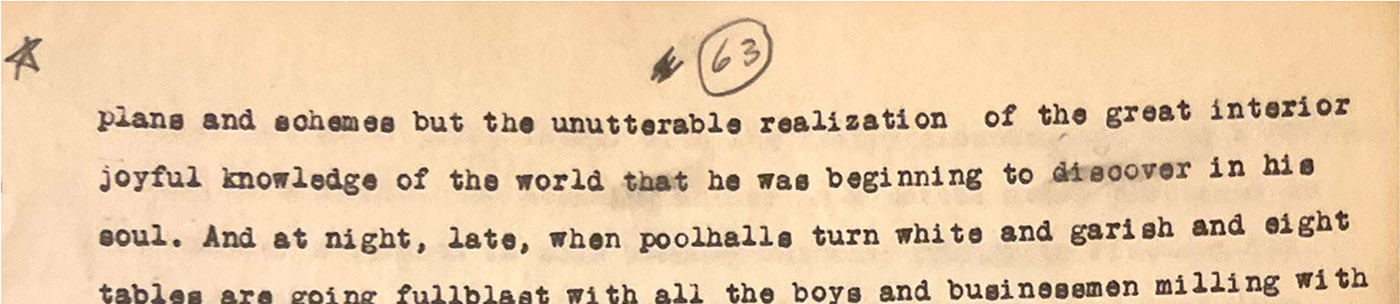
Turning over to the pages that had originally been 4 to 12, I found the matching missing section pertaining to the ‘Lil Neal material’ (see Figure 18) – these were now pages 63 to 71. Similarly, the ‘Material of Ha? Neal?’ was also to be found here. At long last, I had found three of the missing inserts for Sur le chemin, and here they were in English, not French, and part of another novel entirely. This was without a doubt a fascinating, bilingual example of what John Bryant calls a ‘fluid text’. What I had never realised before this moment in my search for the missing inserts was that Sur le chemin was a bilingual novel – prior to this, I had exclusively sought French writings to reconstitute the missing parts of the novel. But the new evidence meant that Kerouac, during its very inception, had designed it as a novel that incorporated segments that he had already composed in English, and that were plucked from Visions of Cody – or rather, from ‘ON THE ROAD’, ‘sur le chemin’ indeed.
Newly equipped with the knowledge that the only remaining missing insert, ‘FROM LEO DULUOZ TO RUEFUL GHOSTS – THEN BACK ONE PAGE’, could therefore also be in English, and not necessarily in French, I was able to locate it almost immediately. It had been under my nose the entire time: the complete insert was scattered across the two main Sur le chemin notebooks (39.5 and 39.10) but, unlike the other English inserts, it has not been extracted from On the Road/Visions of Cody but had been originally composed in English for Sur le chemin. During the reconstruction process, I had erroneously dismissed these English segments from the notebooks, as I had been under the impression that only French inserts could fill the holes in the tapestry of Sur le chemin. In Kerouac’s typescript translation, this insert corresponds to one of the gaps: the missing pages 24 through 32, which further contributed to its mystery as I could not even read it in typed format.
The lengthy process of transcription and textual reconstitution I undertook to consolidate the complete Sur le chemin, and especially the back-and-forth exercise between manuscript and typescript, further led me to realise that a similar process served the same purpose for Kerouac himself. It became evident that Kerouac would use the translating phase at the typewriter to consolidate and stitch together his tale, to construct what would later be ironically called the ‘original’, and also to make further edits and changes. This was a revolutionary insight into Kerouac’s novelistic practice. Even when he wasn’t translating, he would still surround himself with his notebooks at his desk and then thread the novelistic order through the act of typing. In this way, when his manuscripts were bilingual – like Maggie Cassidy – no one was the wiser as he only handed in typescripts to friends and publishers, and filed away the original French manuscripts in his private papers. As he had stated to Cassady in the 1953 letter cited earlier, ‘I will hand it in soon as I finish translating and typing’. Indeed, in a 1950 letter to Yvonne Le Maître where Kerouac predicted that he would one day write a novel in French, he had written: ‘Someday, Madame, I shall write a French-Canadian novel, with the setting in New England, in French... If anybody wants to publish it, I mean Harcourt, Brace or anybody, they’ll have to translate it’ (1995, p. 229). It is important to underscore that in the early 1950s, it was inconceivable for Kerouac to think of his native language – in written form – as publishable; it was a non-existent literature that had no audience yet, except in translation. This mindset is reflected in his marginal notation accompanying the listing of his two French novellas in the 1954 inventory: he not only underscores that they are ‘untyped’, but also ‘untranslated’. That he could only imagine these works appearing in print once they had been translated into English reflects something essential about how foreclosed to a wider public Kerouac felt his French writings to be; to be a writer in America meant you had to write in English. When he writes in French, then, it’s always as a kind of private form of creation that can never be unveiled elsewhere as itself.
Here we can begin to feel just how emotionally damaging this rigid publishing impossibility must have felt, as it would for any minority writer attempting to use a disenfranchised dialect as literature. ‘The best writing’, Kerouac writes in ‘Essentials of Spontaneous Prose’, ‘is always the most painful personal wrung-out tossed from cradle warm protective mind’ (1993, p. 70). But since the language of his ‘cradle warm protective mind’ is French, and this French remains unpublishable, then the spontaneous method is always compromised, or at least mediated by complex processes of translation. Indeed, in one of his short French pieces from 1951, Kerouac delineates that his writerly career will be defined by this precise order of French first, English second. He writes: ‘L’ouvrage de ma vie serait écrit dans la langue que j’ai commencez la vie avec... L’Anglais ça viendra le deuxième tour de composition’ (‘My life’s work would be written in the language that I began my life with... English’ll come the second round of composition’) (2016b, p. 267, my translation). What is particularly tantalising about this declaration is that it turns everything he’s ever published into a translation of sorts – something that comes in the second round – and thus always already complicates the myth of spontaneous prose. I believe this makes Kerouac an unexpected yet important case study in acknowledging the role of translation in the formation of originals. As Karen Emmerich puts it in her masterful Literary Translation and the Making of Originals, ‘translation doesn’t just edit or manipulate some preexisting, stable “source”, but rather continues a process of textual iteration already at work in the language of initial composition’ (2017, p. 10).
*
In closing, I’d like to return to that final long insert in English – lasting roughly 3000 words – that allowed me to finally ‘complete’ Sur le chemin. This narrative section consists of a genealogical history of Kerouac’s paternal side – here named the Duluoz clan instead of the Kerouacs – from the first ancestor to arrive in New France through ‘the mouth of the St Lawrence River, bay of entry for the Bretons of the net from Armorica’, to the ‘Gaspé Peninsula in the North, by Rivière du Loup’, ‘near the mile-wide St Lawrence maw in those awful Baffin sweeps, a plain Mongol and bleak and harsh like Abraham’, to his carpenter grandfather ‘who built his own house in Nashua’ and finally to Ti Jean Duluoz’s father, Leo, one of Sur le chemin’s protagonists (‘Old Bull in the Bowery’, 2016a, pp. 193–94). This history is valuable on multiple registers – not the least of which is its laying bare the French-Canadian diaspora across the American continent.
The English in this section is often ‘Frenchified’, as Kerouac called it (2004, p. 259), and includes many moments of ‘French Canadian’ dialogue, such as in this example:
People in French Canadian patois said ‘The damn Duluozes, all they can do is jabber and eatin and chewin life to death, and it’s cry, and it’s cry – they’re all afraid to die’. And people said ‘They’re all a-scared to die but they all want to swallow everything in sight, round tous rond, ils veul envalées la vache tous rond, the whole cow’ – the whole hog, pigs of life, with great pink tears in their eyes […]. [‘Old Bull in the Bowery’, 2016a, p. 194]
The Duluozes are given astounding descriptions in wild rushing language. Here’s Joseph Duluoz:
[…] a grocer built like a pickle barrel, 230 pounds, bilious sufferings made his face gray like doom, tragic as an undertaker’s curtains on a dark afternoon, the furious summing pathetic caricature of all the Duluozes in him was packed inpent unkeepable explosions of sorrow, mournful huge man, he had the soul of a harassed saint, he was a big, good man trying to endure life and so much of it enlivening his great gut, throbbing there, lamentationing, sometimes he couldn’t stand it and flew into enthusiasms and coughs that shook the ceiling […]. [‘Old Bull in the Bowery’, 2016a, p. 195]
Another uncle, Ernest Duluoz, is given one of the most memorable descriptions and is notably labelled ‘the original Canuck’ and compared favourably to a ‘Yankee’:
Ernest Duluoz had thin lips and an icy face, he had no particular feeling for his brothers; he walked away from their funerals talking about his house. […] He was a railroad brakeman and then a carpenter; there never was an American white garage putterer with tools and hobbies like the original Canuck with his miserly cold dead calm; no Yankee to out freeze him, to make a better fire on a cold day, use less wood, save more words. He outlived them all. [‘Old Bull in the Bowery’, 2016a, p. 195]
On the whole, the ‘Duluoz Clan’ insert is a grandiose and masterful section of Sur le chemin.
The section is especially important, I believe, in contextualising the remarkable statement Kerouac had made about Sur le chemin in his 1953 letter to Cassady, namely that this French novel was ‘the solution to the ‘“On the Road” plots all of em’. Part of what informs my thinking are a brief set of notes jotted onto a loose scrap of torn paper that Kerouac inserted within the pages of the first Sur le chemin notebook. On one side, he writes: ‘In French a pithy, short, Balzaccian novel; in English a profound American Prose novel… converting one to another, first to second, translating, deepening, opening out, continenting…’ (JKP, Box 39, Folder 10). I am particularly fond of this statement as it unites the French and the English as a process that converts ‘one to another, first to second’ – in a way that recalls the other statement, cited earlier, that ‘English’ll come the second round of composition’ – an alchemy that eventually leads to a ‘continenting’ of America. On the other side of that same torn piece of paper, Kerouac writes: ‘For the sake of getting to pure fiction and pure autobiography, I want to dispatch this mixed French On the Road (written Mexicay)’. As this essay suggests, the only way Kerouac could ‘dispatch’ this ‘mixed French On the Road’ was after a process of typing and translating that Kerouac was ultimately unable to complete, even though his archive contains traces of his many attempts in the years that followed initial composition.
Importantly, his archive further shows that Kerouac also tried to reuse and revise the French-Canadian ‘Duluoz Clan’ section in a slew of other aborted narratives. Two of these unfinished narratives are over 20,000 words in length. In the one titled ‘Duluoz – Parable of America’, the story takes place in Québec, mostly in Montréal and in the surrounding farmlands north of the city. Kerouac’s other concerted attempt to reuse the genealogy is titled ‘On the Road – History of the Loves and the Bretagnes’, the latter being the last name of his alter ego in La nuit est ma femme. Taken together, the many versions of the fictionalised Kerouac/Duluoz/Bretagne line’s arrival and survival on the American continent form a kind of grand French-Canadian epic or, to use his word, a ‘Parable of America’. By inscribing French-Canadian diaspora so thoroughly, tracing the line all the way back to the Breton ancestor and up to Ti Jean Duluoz himself, Kerouac is able, at last, to firmly situate his heritage, ethnicity, language, and culture within the symbolic structure of (North) America, which proves to be a foundational hope for Kerouac’s literary project as a whole. As such, I believe that Kerouac considered Sur le chemin to be ‘the solution to the “On the Road” plots all of em’ in part because it is the novel in which he embedded this genealogy, and because it was bilingual, a ‘mixed FrenchOn the Road (written Mexicay)’, a line that pithily continents Québec, the United States, and Mexico. That Kerouac tried to reuse his dramatised genealogy in subsequent versions and make explicit the diasporic migration further points to its symbolic importance for its author.
Ultimately, the imperfect itineraries I followed during the reconstitution journey nevertheless brought me to destinations I had not even imagined when I initially set forth. This nicely mirrors Kerouac’s On the Road itself; perhaps I was in effect hitchhiking my way through his archive, holding up call slips with thumb and forefinger, and all those unexpected stops, chance encounters, unplanned turns, all those alternative itineraries forever redrew my inner map of the Kerouac landscape. Yet if Kerouac had not kept such meticulous records, and if Kiely had not so carefully described his arrangement, we would likely be lost in this archive, which today stands as Kerouac’s final gesture of preservation and survivance. What he could not save through the resilience of literary form, he did through careful preservation of records.9 In other words, when Kerouac the novelist, or Kerouac the translator, failed, Kerouac the archivist was there to save him.
1For examples of Kerouac’s childhood box scores and early diaries, see Gewirtz, 2007; 2009.
2Kerouac typed The Dharma Bums scroll in November 1957, two months after On the Road was published in September 1957, but the novel’s raw materials, taken from his notebooks, had already been written.
3Interestingly, Kerouac also labels two works as ‘lost’: all of his cartoons and ‘Haunted Life’. The manuscript for The Haunted Life resurfaced on auction at Sotheby’s in 2002. For more on the history of this manuscript, see Cloutier, 2019.
4Sampas was named literary executor of the Kerouac estate after Kerouac’s wife, Stella Sampas, passed away in 1990.
5Brunelle, who passed away in 2020, was one of the founders of the yearly Lowell Celebrates Kerouac! Festival and his guided tours of Kerouac’s childhood town ‘highlighted and celebrated Kerouac’s French-Canadian heritage – a heritage Roger shared – as well as Kerouac’s intricate use of the French-Canadian language in many of his novels’ (Edington, 2021).
6This embargo only covered the materials that NYPL had acquired in the 2001 sale. In other words, although this represented the bulk of the Kerouac Archive, the other materials that NYPL had been previously acquiring since the 1990s were not affected by this embargo and were thus available to the few scholars who were aware of this ‘loophole’ at the time. These include Tim Hunt, Nancy Grace, Paul Maher, Jr, and others.
7For the original French, see La vie est d’hommage, Kerouac, 2016b, pp. 54–55. And just so there’s no misunderstanding, let me assure you that I am not the one collecting any monies with the release of these posthumous works.
Brinkley Douglas, 1998, ‘In the Kerouac Archive’, The Atlantic Monthly, November, p. 63.
Bryant John, 2002, The Fluid Text: A Theory of Revision and Editing for Book and Screen, Ann Arbor, University of Michigan Press. Available at: https://doi.org/10.3998/mpub.12024.
Cloutier Jean-Christophe, 2019, ‘Kerouac on Auction: Gotham Book Mart and the Mysteries of The Haunted Life Manuscript’ [oral presentation], Modernism – Materiality – Meaning, Kislak Conference, 2 March.
Cloutier Jean-Christophe, 2024, ‘The Essentials of Archival Prose’, in Belletto Steven (ed.), The Cambridge Companion to Jack Kerouac, Cambridge, Cambridge University Press. Available at: https://doi.org/10.1017/9781009423571.020.
Emmerich Karen, 2017, Literary Translation and the Making of Originals, New York, Bloomsbury Academic. Available at: https://doi.org/10.5040/9781501329944.
Gewirtz Isaac, 2007, Beatific Soul: Jack Kerouac on the Road, New York/London, The New York Public Library/Scala Publishers.
Gewirtz Isaac, 2009, Kerouac at Bat: Fantasy Sports and the King of the Beats, New York, The New York Public Library.
Glissant Édouard, 2010, L’Imaginaire des langues. Entretiens avec Lise Gauvin (1991-2009), Paris, Gallimard.
Johnson Joyce, 2012, The Voice is All: The Lonely Victory of Jack Kerouac, New York, Viking.
Kerouac Jack, 1993, ‘Essentials of Spontaneous Prose’, in id., Good Blonde & Others, ed. by Allen Donald, San Francisco, Grey Fox Press, pp. 69–71.
Kerouac Jack, 1995, Selected Letters: 1940–1956, ed. by Ann Charters, New York, Viking.
Kerouac Jack, 1999, Selected Letters: 1957–1969, ed. by Ann Charters, New York, Viking.
Kerouac Jack, 2004, Windblown World: The Journals of Jack Kerouac: 1947–1954, ed. by Brinkley, New York, Viking.
Kerouac Jack, 2015, Visions of Cody / Visions of Gerard / Big Sur, New York, Library of America.
Kerouac Jack, 2016a, The Unknown Kerouac: Rare, Unpublished & Newly Translated Writings, ed. by Todd Tietchen, trans. from French by Jean‑Christophe Cloutier, New York, Library of America.
Kerouac Jack, 2016b, La vie est d’hommage, ed. by Jean‑Christophe Cloutier, Montréal, Éditions du Boréal.